
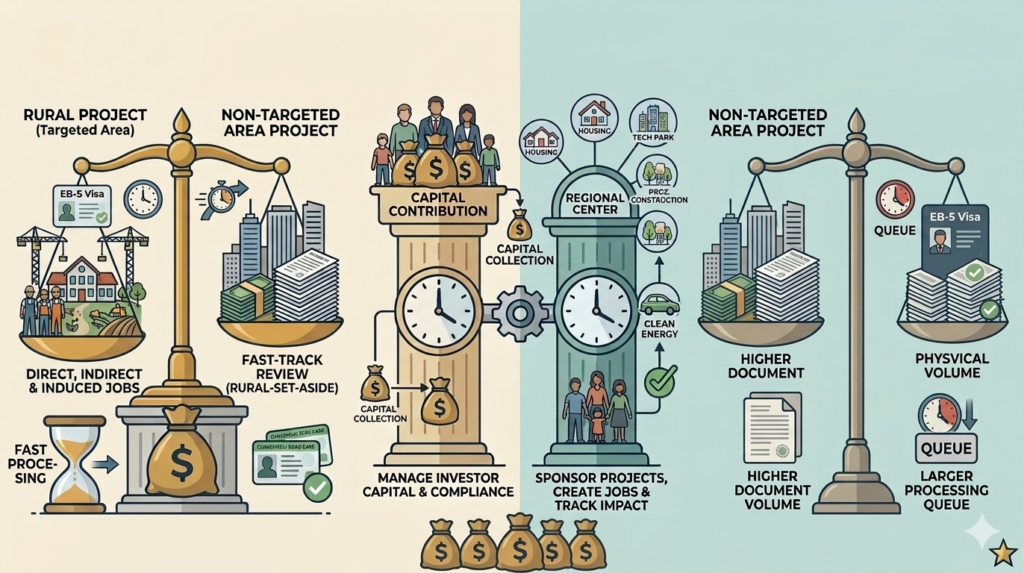
In recent years, rural EB-5 projects have attracted a lot of investor attention. Many families ask me the same question: Why do people say rural EB-5 may be faster?
The short answer is that rural EB-5 projects may benefit from two advantages: reserved visa availability and priority processing treatment. But investors should understand what this means, and also what it does not mean.
Rural Projects and Reserved Visas
Under the current EB-5 framework, certain visa numbers are reserved each fiscal year for specific categories. USCIS states that 20% of annual EB-5 immigrant visas are set aside for rural area investments, 10% for high-unemployment area investments, and 2% for infrastructure projects.
This matters because EB-5 investors from high-demand countries may face visa backlog in the unreserved EB-5 category. A reserved visa category may provide a separate pool of visa numbers, which can be very important for families who are concerned about timing.
Rural projects receive the largest reserved visa allocation among the set-aside categories. This is one reason rural EB-5 has become especially popular among investors from countries such as China and India, where visa availability has historically been a major issue.
Priority Processing for Rural Petitions
Another reason rural EB-5 may move faster is that rural petitions have been given priority treatment under the EB-5 Reform and Integrity Act framework. In practical terms, this means USCIS may handle rural-related petitions with priority compared with some other EB-5 filings.
However, investors should be careful with the word “faster.” Faster does not mean guaranteed approval. It also does not mean every rural project will be processed within the same timeline. USCIS processing still depends on many factors, including case volume, project documents, source-of-funds complexity, USCIS workload, and whether the case receives questions or requests for evidence.
Why Timing Matters So Much
For many families, timing is not just a convenience issue. It can affect children’s education, age-out risk, work authorization, adjustment of status planning, and relocation decisions.
I have met families whose children were already studying in the U.S. on F-1 visas. Some were close to graduation. Some were approaching age 21. For these families, EB-5 timing can become very emotional because delays may affect the whole family’s plan.
This is why rural EB-5 is often discussed early in investor consultations. If a family has strong timing pressure, rural projects may be worth reviewing. But timing should never be the only consideration.
Faster Does Not Always Mean Safer
One mistake I see is that some investors hear “rural may be faster” and immediately assume rural is the best choice. That is not always true.
A rural project still needs strong fundamentals. Investors should review whether the project is truly located in a qualifying rural area, whether the job creation model is strong, whether there is enough job cushion, and whether the project has a realistic business plan.
Financial risk also matters. Rural markets may be smaller than major urban markets. Some projects may have fewer exit options, lower liquidity, or more dependence on one operating business. The investor should understand how the project plans to repay EB-5 capital. Is repayment based on refinancing, property sale, operating revenue, or another capital event?
What Investors Should Review
Before choosing a rural EB-5 project, I usually suggest investors review several questions:
Is the rural qualification clearly documented?
Does the project already have I-956F filing or approval?
How many jobs are expected per investor?
Is there enough job cushion if the project is delayed?
Who is the developer or project sponsor?
What is the capital stack?
What is the exit strategy?
How will the investor receive project updates?
These questions help investors avoid choosing a project only because it is labeled “rural.”
Final Thoughts
Rural EB-5 projects may receive faster processing because they are supported by reserved visa allocation and priority treatment. For families with timing concerns, this can be very important.
But rural EB-5 should still be reviewed carefully. Faster processing does not remove investment risk, job creation risk, source-of-funds requirements, or project risk.
In my experience, rural EB-5 may be a strong option when the project has both timing advantages and solid fundamentals. The best decision is not simply choosing rural. It is choosing a rural project that also makes sense from an immigration, investment, and family planning perspective.