
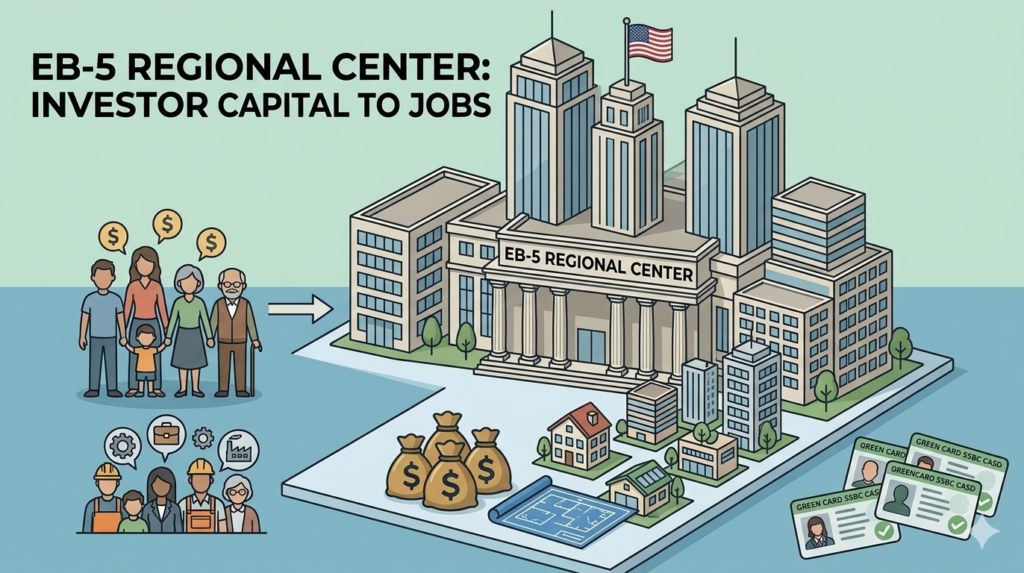
When investors first enter the EB-5 world, one of the most confusing terms they hear is regional center. Many investors ask me, “Is the regional center the developer?” “Is it the government?” “Does it guarantee my green card?” “Is my money paid to the regional center?”
These are important questions because the regional center plays a major role in many EB-5 projects, but investors often misunderstand what it actually does.
What Is a Regional Center?
An EB-5 regional center is an entity designated by USCIS to promote economic growth through EB-5 investment activity within a specific geographic area. USCIS maintains a list of approved EB-5 regional centers and also reminds investors that regional center approval does not mean USCIS endorses or guarantees any specific investment. Investors still need to perform their own due diligence.
In simple terms, a regional center is not the same as USCIS, and it is not automatically the developer. It is a USCIS-designated sponsor that can support EB-5 projects and help structure them for EB-5 compliance.
Why Regional Centers Matter
The main reason regional centers are important is job creation. In regional center EB-5 projects, investors may be able to count indirect jobs created through economic activity, not only direct employees. USCIS states that up to 90% of the job creation requirement for regional center investors may be met using indirect jobs.
This makes regional center EB-5 practical for large projects. For example, a hotel, apartment development, infrastructure project, or manufacturing facility may create jobs through construction spending, operating revenue, and other economic impacts. An economist may prepare a report to estimate the job creation based on accepted economic methodology.
For many investors, this is easier than directly hiring and maintaining 10 full-time employees themselves.
What Does a Regional Center Do?
A regional center may help with several parts of the EB-5 structure. It may sponsor the project, coordinate with the developer, prepare or review EB-5 project documents, work with economists, support the I-956F project filing, and provide project updates needed for investors’ immigration filings.
However, the exact role depends on the project. Some regional centers are deeply involved in project structuring and compliance. Others may mainly act as sponsors while the developer or fund manager handles most of the project execution.
This is why investors should ask: What exactly does this regional center do in this project? How long has it been operating? How many projects has it sponsored? What is its track record? Has it had any compliance problems? How does it support investors during I-526E and I-829?
Regional Center vs Developer
Many investors confuse the regional center with the developer. In some projects, they may be related parties. In others, they may be separate.
The developer is usually the party building or operating the project. The regional center is the EB-5 sponsor. The new commercial enterprise is usually the entity into which EB-5 investors invest. The job-creating entity is usually the project company that uses the funds to create jobs.
Understanding these roles is important because different parties have different responsibilities. If you do not know who controls the money, who builds the project, who creates jobs, and who reports to investors, you may not fully understand your investment.
Does a Regional Center Guarantee Approval?
No. This is one of the most important points.
A regional center designation does not guarantee that the project is safe, that the investor’s petition will be approved, or that the capital will be returned. USCIS approval of a regional center means the entity has been designated under EB-5 rules, but investors still need to review each project carefully.
In my experience, this is where many investors make mistakes. They hear “approved regional center” and assume the project is approved by the government. That is not the right way to think about it. Regional center designation is only one part of the review.
Final Thoughts
A regional center can play a very important role in EB-5. It can help sponsor projects, support job creation methodology, coordinate compliance, and provide the structure many passive investors prefer.
But investors should not choose a project only because it has a regional center. You should understand the regional center’s role, the developer’s role, the project structure, job creation, capital stack, and repayment strategy.
After working with many EB-5 families, I usually explain it this way: the regional center is part of the EB-5 system, but it is not a guarantee. A good investor should understand not only the name of the regional center, but how the entire project works.