
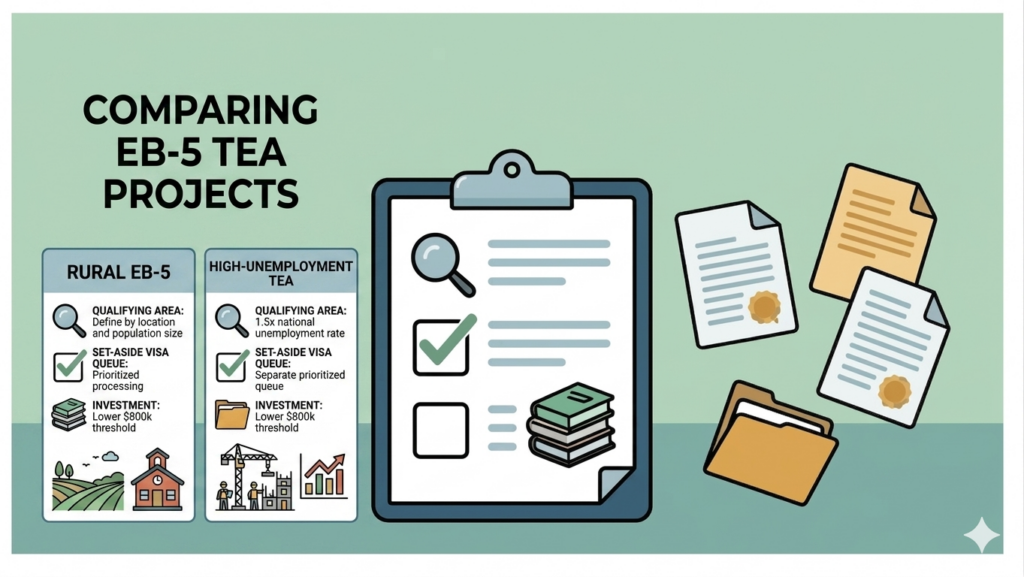
Many EB-5 investors today hear two phrases very often: rural projects and high-unemployment (HUA). Both may qualify for the reduced EB-5 investment amount, and both may fall under reserved visa categories. But they are not the same.
From my experience, many investors understand that rural and high-unemployment projects can be attractive, but they do not always understand the differences. This matters because the category you choose may affect visa availability, processing expectations, project type, and risk review.
What Is a TEA?
TEA stands for Targeted Employment Area. In EB-5, a TEA generally refers to either a rural area or an area with high unemployment. Investments in qualifying TEA projects may be eligible for the reduced investment amount. USCIS currently lists the general EB-5 investment amount as $1,050,000, with $800,000 available for qualifying targeted employment area (rural / HUA) or infrastructure investments.
After the EB-5 Reform and Integrity Act, reserved visas became a major reason investors pay attention to TEA categories. USCIS states that
- 20% of annual EB-5 visas are set aside for rural area investments.
- 10% for high-unemployment area investments.
- 2% for infrastructure projects.
Rural EB-5 Projects
A rural EB-5 project is located in a qualifying rural area. These projects may include resorts, manufacturing facilities, senior living communities, energy projects, agricultural processing, infrastructure-related developments, or other projects outside major metropolitan areas.
The biggest attraction of rural EB-5 is that rural investments receive the largest set-aside allocation: 20% of annual EB-5 visas. Rural cases also receive special attention because USCIS has indicated priority treatment for rural petitions under the current EB-5 framework. This is why many investors with timing concerns are interested in rural projects.
However, rural does not automatically mean low risk. Some rural projects may be in smaller markets with less liquidity, fewer exit options, slower resale potential, or more dependency on one business plan. Investors should review whether the project has real demand, strong sponsorship, realistic job creation, and a credible repayment source.
High-Unemployment Area
High-unemployment Area projects are usually located in areas where unemployment is high enough to meet EB-5 requirements. These projects are often in urban or suburban markets. Many investors like this category because the project may be in a more familiar city, with a larger population, stronger market demand, or more developed infrastructure.
High-unemployment projects receive a 10% annual visa set-aside under USCIS guidance. This is lower than the rural set-aside, but still meaningful for investors who want to avoid the unreserved EB-5 backlog.
High-unemployment projects may feel more comfortable to some investors because they are often located in larger cities.However, investors should not choose a project only because the city name sounds strong. You still need to review the exact location, market demand, capital stack, job creation methodology, and exit strategy.
Comparison
| Topic | Rural EB-5 | High-Unemployment Area |
| Reduced investment | Usually yes if qualified | Usually yes if qualified |
| Reserved visa allocation | 20% | 10% |
| Common location | Outside major metro areas | Often urban or suburban |
| Investor attraction | Timing and visa set-aside | Familiar markets and reduced amount |
| Main risk to review | Market size, exit options, project demand | TEA validity, competition, capital structure |
Which One Should Investors Choose?
The right answer depends on your priorities. If timing is your biggest concern, rural projects may deserve serious attention because of their larger set-aside allocation and priority treatment. If you prefer a project in a larger market, a high-unemployment Area project may feel more familiar.
But I always remind investors: category is only the first filter. It is not the final decision.
A rural project with weak fundamentals may be riskier than a strong high-unemployment project. A high-unemployment project in a famous city may still have repayment or job creation risk. Investors should review the full project, not only the TEA label.
Final Thoughts
Rural and high-unemployment Area projects can both be useful EB-5 options. They may offer the reduced investment amount and access to reserved visa categories. But they are different tools for different investor needs.
Before making a decision, ask: Is my priority timing, location, project quality, repayment, or a balance of all of them? Once you know your priority, comparing rural and high-unemployment projects becomes much easier.