
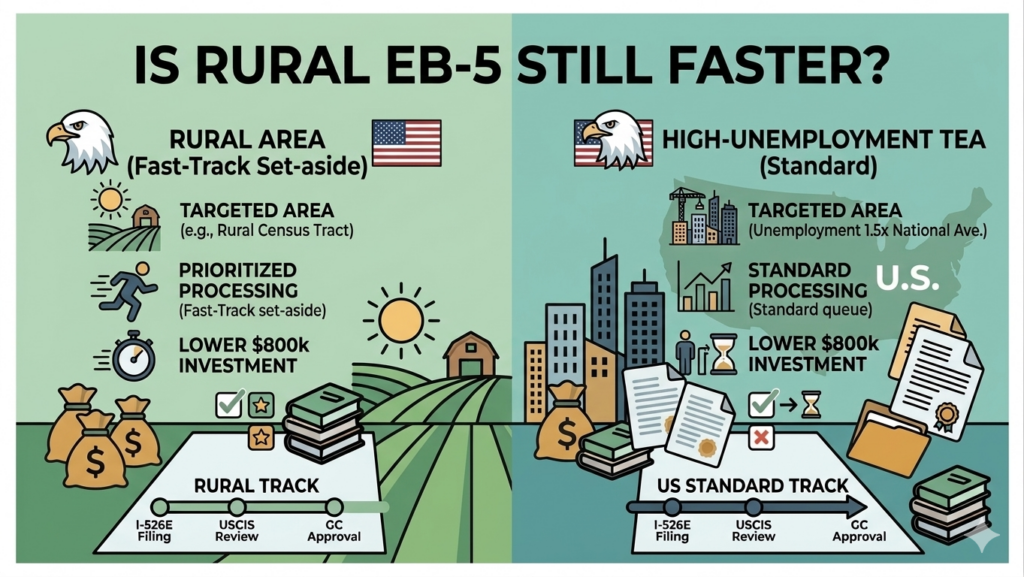
Over the past year, many EB-5 investors have been asking a very practical question: Is rural EB-5 still faster?
This question is understandable. Since the EB-5 Reform and Integrity Act created reserved visa categories, rural EB-5 projects have become very popular, especially among investors from countries with historically high EB-5 demand. Rural projects receive a larger reserved visa allocation than high-unemployment area projects, and rural petitions have also received special attention in USCIS processing policy. USCIS confirms that EB-5 visas are reserved each fiscal year for rural investments, high-unemployment area investments, and infrastructure projects, with 20% reserved for rural, 10% for high-unemployment areas, and 2% for infrastructure.
But popularity also creates a new concern: if too many investors choose rural projects, will rural EB-5 also become backlogged?
My answer is: rural EB-5 may still have more runway than high-unemployment area projects, but it is not risk-free. Investors should not treat “rural” as a magic word. It is still important to understand visa demand, I-485 inventory, project quality, and family timing.
Why Rural EB-5 Became So Popular
Rural EB-5 became attractive for two main reasons.
First, rural projects receive the largest reserved visa allocation. Compared with high-unemployment area projects, rural has double the annual reserved visa percentage: 20% versus 10%. For investors from China, India, and other high-demand countries, this difference matters because visa availability can affect when a family can actually receive conditional green cards.
Second, rural petitions may benefit from priority processing attention. This does not mean every rural case will be approved quickly, and it does not guarantee approval. But from a timing perspective, rural has been viewed as one of the strongest EB-5 categories under the current program.
This is why many investors, especially those with children close to 21 or students already in the U.S., have focused heavily on rural projects.
What the I-485 Inventory Tells Us
The recent discussion around rural and high-unemployment EB-5 demand comes partly from pending I-485 inventory data. Form I-485 is used by applicants already in the United States to apply for adjustment of status. USCIS publishes employment-based I-485 inventory data to show how many adjustment applications are pending in different employment-based categories.
According to the video summary you shared, rural EB-5 adjustment pending inventory is around 7,600+, while high-unemployment area inventory is around 8,200+. These numbers suggest that both categories now have real demand. Rural is not empty, and HUA is not a small category anymore.
However, this data must be read carefully. Pending I-485 inventory does not mean every case already has an approved I-526E or is ready for final green card approval. The inventory may include principal investors, spouses, and children. It may also include cases that are still waiting for investor petition approval, cases that later receive denials, withdrawals, transfers, or corrections, and possibly some duplicate or multiple pending filings.
So the inventory is useful, but it is not the same as “approved and visa-ready demand.”
Why HUA Looks More Pressured Than Rural
The most important comparison is not just the raw number of pending cases. It is the relationship between pending inventory and available visa supply.
Based on the data you summarized, HUA has a similar or even slightly higher pending I-485 inventory than rural. But HUA receives only 10% of annual EB-5 visas, while rural receives 20%. That means HUA has roughly similar demand pressure but only half the reserved visa allocation.
This is why HUA appears more vulnerable to retrogression before rural. The category may simply have less visa supply to absorb the same level of demand.
For investors, this does not mean HUA is a bad option. A strong HUA project in a good market may still be attractive. But from a visa-demand perspective, investors should understand that HUA may face pressure earlier if demand continues to grow and more cases become ready for visa use.
Rural Has More Runway, But Not Unlimited Runway
Rural still appears to have more breathing room because it receives a larger visa set-aside. But that does not mean rural can never retrogress.
Demand is growing fast. More investors are choosing rural because they believe it may be faster. More projects are being marketed as rural. More families with children in the U.S. are using rural EB-5 as a timing strategy. If USCIS and the Department of State begin using reserved visa numbers more actively, rural demand may also start to pressure the Visa Bulletin.
This is why I usually tell investors: rural may still be stronger than HUA from a visa-supply perspective, but it should not be treated as unlimited.
The Department of State Visa Bulletin remains the key source for whether a category is current or backlogged. Recent Visa Bulletins have shown EB-5 set-aside categories listed as current, but that can change if demand exceeds available visa supply.
Inventory Movement Is a Positive Sign
One positive point from the inventory discussion is that the pending cases do not appear to be completely frozen. Your video summary notes that some earlier rural priority-date counts reduced compared with prior inventory reports.
That kind of reduction may come from different reasons: approvals, denials, withdrawals, transfers, duplicate corrections, or other updates. We should not assume every reduction means approval. But it is still meaningful because it suggests that the inventory is moving.
For investors, this is important. A growing inventory is a concern, but movement in the inventory is a sign that USCIS is not simply leaving all reserved EB-5 adjustment cases untouched.
What This Means for Indian Investors
Many Indian investors are especially focused on rural EB-5 because they are trying to avoid long backlogs in other categories. The rural inventory for India is meaningful, but based on the data you shared, it does not necessarily mean India rural is already impossible or completely blocked.
One important point is that the I-485 inventory includes derivatives, not just principal investors. A family of four may appear as four pending I-485s, even though it represents one EB-5 investment. Also, many pending cases may have later 2025 or 2026 priority dates, which means the demand is real but spread across filing periods.
Indian investors should take the data seriously, but not panic based on inventory numbers alone.