
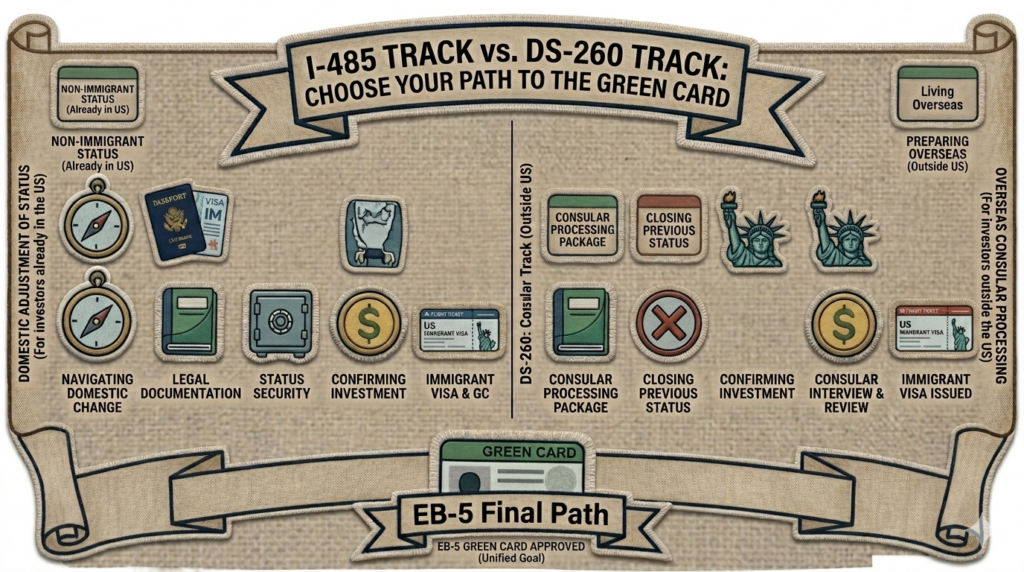
After filing an EB-5 petition, investors often hear about two additional forms: Form I-485 and Form DS-260.
In general:
- Form I-485 is used for adjustment of status inside the United States.
- Form DS-260 is used for immigrant visa processing through a U.S. embassy or consulate outside the United States.
| Issue | Form I-485 | Form DS-260 |
|---|---|---|
| Full name | Application to Register Permanent Residence or Adjust Status | Immigrant Visa and Alien Registration Application |
| Main process | Adjustment of status | Consular processing |
| Applicant’s usual location | Inside the United States | Outside the United States |
| Main government agency | USCIS | U.S. Department of State |
| Where the case is decided | USCIS | U.S. embassy or consulate |
| Interview | USCIS may schedule an interview | An immigrant visa interview is generally required |
| How conditional residence begins | When USCIS approves the I-485 | When the applicant enters the United States using the immigrant visa |
| Possible filing before EB-5 petition approval | Sometimes, through concurrent filing when eligible | Generally no; the approved petition normally proceeds to immigrant visa processing |
| Work and travel applications while pending | May be available separately | Not provided through the DS-260 process |
———-I-485———-
What Is Form I-485?
Form I-485 is used by certain applicants who are already physically present in the United States and want to become permanent residents without leaving the country for immigrant visa processing.
This procedure is called adjustment of status.
An investor cannot assume that being physically present in the United States automatically makes an I-485 filing possible. The applicant must meet the applicable adjustment-of-status requirements, and an immigrant visa must generally be immediately available.
Factors that may affect eligibility include:
- The investor’s current immigration status;
- Whether the investor entered the United States lawfully;
- Whether the investor has maintained the required status;
- The investor’s immigration and travel history;
- Visa availability under the applicable EB-5 category;
- Possible grounds of inadmissibility; and
- Whether any exceptions or special rules apply.
Because these questions are highly fact-specific, the investor’s immigration attorney should review eligibility before an I-485 is filed.
Can an EB-5 Investor File I-485 Before I-526E Approval?
In some cases, yes.
An eligible EB-5 investor in the United States may be able to file Form I-485 together with Form I-526E or while the I-526E remains pending. This is commonly called concurrent filing.
Concurrent filing may be available when an immigrant visa is immediately available under the applicable Visa Bulletin rules and the investor otherwise qualifies to adjust status.
This option can be important for investors already living in the United States under statuses such as F-1, H-1B, L-1, or another qualifying classification. However, the consequences can differ significantly depending on the person’s existing status.
Filing an I-485 also demonstrates an intention to become a U.S. permanent resident. This can affect future nonimmigrant visa applications, international travel, and the investor’s strategy for maintaining lawful status.
Concurrent filing should therefore be treated as an immigration planning decision, not simply as a way to submit more forms sooner.
Can an I-485 Applicant Work While the Case Is Pending?
An investor who files Form I-485 may also be eligible to submit a separate application for employment authorization.
If approved, the employment authorization document may allow the applicant to work in the United States while the I-485 remains pending.
However, filing the I-485 does not by itself grant unrestricted employment authorization. The investor must either:
- Continue to hold another status that permits employment; or
- Receive separate employment authorization connected with the pending I-485.
Investors should also understand how using adjustment-based employment authorization could affect their existing nonimmigrant status.
Can an I-485 Applicant Travel Outside the United States?
International travel during a pending I-485 requires careful planning.
Many adjustment-of-status applicants apply for advance permission to travel. Leaving the United States without the required travel authorization may, in many circumstances, cause USCIS to treat the I-485 as abandoned.
Certain applicants in particular nonimmigrant classifications may be subject to different rules, but investors should not make travel arrangements based on general assumptions.
Before leaving the United States, the investor and each dependent family member should confirm:
- Whether travel authorization is required;
- Whether it has been approved;
- Whether the traveler still holds another valid status;
- Whether international travel could affect the pending I-485; and
- Whether there are any risks when returning to the United States.
———-DS-260———-
What Is Form DS-260?
Form DS-260 is the online immigrant visa application used by applicants completing the green card process outside the United States.
This procedure is known as consular processing.
After the EB-5 petition is approved and an immigrant visa is available, the case generally moves to the U.S. Department of State’s National Visa Center. The investor and each immigrating family member normally complete a separate DS-260 application. They may also be asked to provide civil and supporting documents, such as:
- Passports;
- Birth certificates;
- Marriage certificates;
- Police certificates;
- Court or military records, where applicable;
- Previous immigration records; and
- Other documents requested for immigrant visa processing.
After the required documents are reviewed, the case is scheduled for an immigrant visa interview at the appropriate U.S. embassy or consulate.
What Happens at the Consular Interview?
During the interview, a consular officer reviews the applicant’s identity, immigration history, family relationship, admissibility, and eligibility for the immigrant visa.
The officer may ask questions about:
- The investor’s EB-5 application;
- The source and transfer of investment funds;
- Previous travel to the United States;
- Past visa applications;
- Employment and education history;
- Criminal or legal matters;
- Medical examination results; and
- The relationship between the principal investor and dependent family members.
An approved I-526 or I-526E petition is an important part of the case, but it does not guarantee that the immigrant visa will automatically be issued. The consular officer still reviews whether each applicant is eligible and admissible to the United States.
When Does a DS-260 Applicant Become a Permanent Resident?
Approval of the DS-260 process results in the issuance of an immigrant visa, not immediate permanent resident status while the applicant remains abroad.
The applicant normally becomes a conditional permanent resident when admitted to the United States using the immigrant visa.
This means the date of entry is important because it generally starts the investor’s period of conditional permanent residence.
That date will later help determine the filing window for Form I-829, which is used to remove the conditions from the investor’s green card.
Do Family Members Use the Same Process?
The investor’s spouse and qualifying unmarried children may generally immigrate as derivative applicants. However, every family member has an individual immigration application.
For adjustment of status, each qualifying family member normally files a separate Form I-485.
For consular processing, each qualifying family member normally completes a separate DS-260 and attends the required immigrant visa process.
A family does not always have to complete every stage in exactly the same location or at exactly the same time. In some situations, the principal investor may adjust status in the United States while family members complete consular processing abroad.
This is sometimes referred to as follow-to-join processing, although whether and how it applies depends on the family’s circumstances.
Families should also consider the age of their children. Long processing times can create concerns about whether a child will remain eligible as a derivative beneficiary. Child Status Protection Act analysis can be complex and should be completed by an immigration attorney.
Is I-485 Faster Than DS-260?
There is no universal answer.
I-485 may appear more convenient because the investor can remain in the United States during the process and may be eligible to request work and travel authorization.
However, I-485 processing times vary by USCIS workload, case location, background checks, requests for evidence, interview requirements, and visa availability.
DS-260 processing also varies depending on:
- When the EB-5 petition is approved;
- Visa availability;
- National Visa Center document review;
- Embassy or consulate capacity;
- Interview availability;
- Medical examination arrangements; and
- Administrative processing after the interview.
Can an Investor Choose Between I-485 and DS-260?
Sometimes an investor may have more than one possible route, but the choice is not based only on personal preference.
For example, an investor lawfully present in the United States may potentially qualify for adjustment of status. An investor living abroad will normally use consular processing.
An investor in the United States may still decide to complete consular processing abroad, but that decision should be carefully evaluated. Changing the intended processing route can create additional procedures, delays, or communication between USCIS and the Department of State.
The choice may depend on:
- Current physical location;
- Existing U.S. immigration status;
- Ability to remain lawfully in the United States;
- International travel requirements;
- Employment needs;
- Family members living in different countries;
- Children approaching the age limit;
- Visa Bulletin movement;
- Prior immigration violations; and
- Personal or business responsibilities outside the United States.
Which Route Is Better for an EB-5 Investor?
Neither route is automatically better.
I-485 may be more suitable when:
- The investor is already in the United States;
- The investor is eligible to adjust status;
- A visa is immediately available;
- The investor wants to remain in the United States during processing; and
- Work and travel planning can be properly managed.
DS-260 may be more suitable when:
- The investor lives outside the United States;
- The investor cannot or does not plan to remain in the United States;
- The investor needs to continue managing a business or family responsibilities abroad;
- Adjustment of status is not available; or
- Consular processing fits the family’s relocation plan better.
The Key Point for Investors
I-485 and DS-260 are not two versions of the same form.
They are two different paths to the same general EB-5 milestone: obtaining conditional permanent residence.
Form I-485 allows an eligible applicant inside the United States to request adjustment of status through USCIS. Form DS-260 allows an applicant outside the United States to request an immigrant visa through the Department of State and a U.S. embassy or consulate.
Before selecting a route, an EB-5 investor should ask:
- Am I eligible to file I-485?
- Is an EB-5 visa currently available to me?
- Can I file concurrently with my I-526E?
- Do I need to travel internationally during the process?
- Do I need U.S. employment authorization?
- Where will my spouse and children complete their applications?
- Are any children at risk of aging out?
- How will each route affect my current immigration status?
- When will my conditional residence begin?
- Which route best fits my family and business plans?
The decision should be made with an experienced U.S. immigration attorney after reviewing the investor’s full immigration history and family circumstances.
This article provides general educational information and does not constitute legal, immigration, tax, or investment advice. Immigration rules, filing procedures, fees, form editions, Visa Bulletin availability, and government processing practices may change. Investors should confirm current requirements with USCIS, the U.S. Department of State, and qualified immigration counsel.