
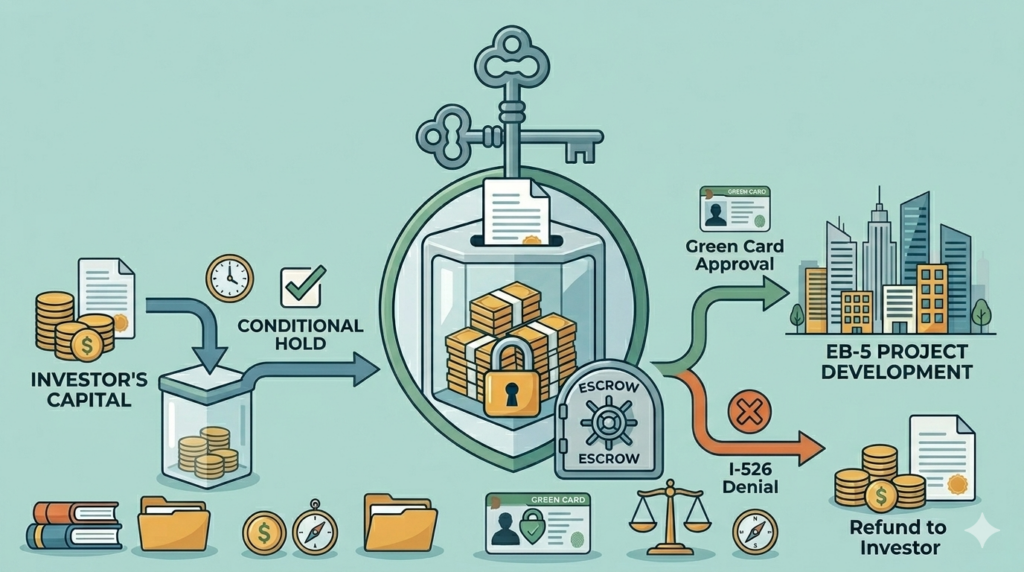
Escrow is a common concept in EB-5 investments. It usually refers to a bank or escrow account where investor funds are held before being released to the project.
In simple terms, escrow is a holding arrangement. The investor transfers money into an account controlled by an escrow agent, and the funds are released only when certain conditions are met. These conditions are usually described in the project documents.
For EB-5 investors, escrow can be used in different ways. Some projects may release funds after the investor files the I-526E petition. Some may release funds after USCIS issues a receipt notice. Others may release funds after petition approval, although this structure may be less common in modern EB-5 offerings because projects often need capital earlier.
Investors should understand that “money in escrow” and “money invested” may not always mean the same thing. EB-5 capital generally needs to be committed to the new commercial enterprise and placed at risk for the purpose of generating a return. If funds are sitting in escrow with too many restrictions, investors should ask whether the structure satisfies EB-5 requirements.
Escrow can provide some procedural comfort, but it is not a guarantee of immigration approval or repayment. The escrow terms matter. Investors should review when funds are released, whether any part is refundable, what happens if the I-526E is denied, and who controls the escrow account.
Additionally, funds must be deployed into the project in order to count towards job creation, being the loan term set within that project’s lending agreement, and also to begin the sustainment period countdown. If funds remain in escrow for too long, then none of the required metrics will be credited to the investor, creating a different set of critical issues during the EB-5 process.
A strong EB-5 review should include both immigration and financial questions. From an immigration perspective, the attorney should evaluate whether the funds are properly invested AND DEPLOYED. From a financial perspective, the investor should understand how quickly the project will use the funds and what risks begin after release.