
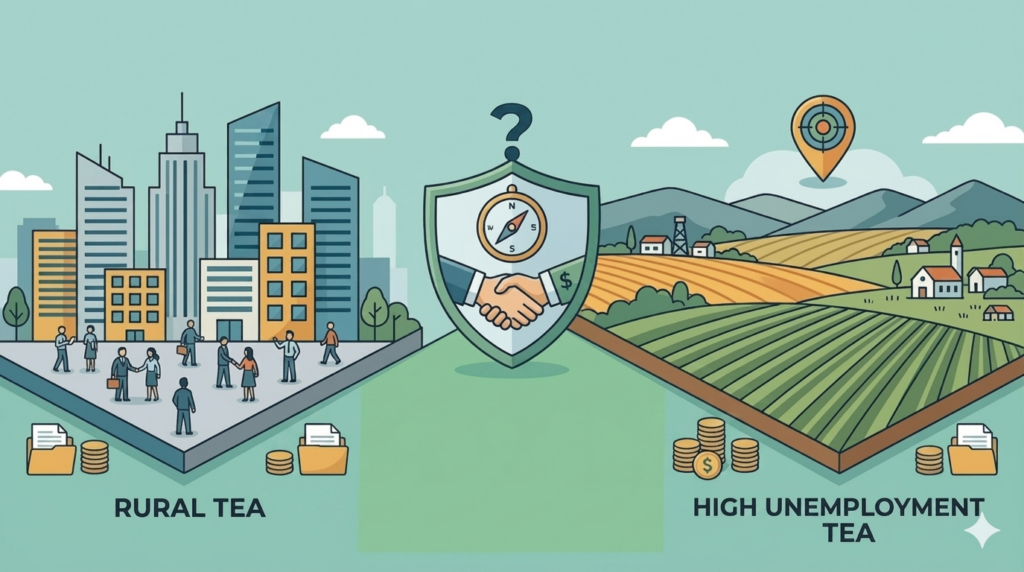
TEA stands for Targeted Employment Area. In EB-5, TEA status is important because it may allow an investor to qualify with the lower investment amount.
Under current USCIS guidance, a TEA can be either a rural area or a high-unemployment area. A high-unemployment area generally must have unemployment of at least 150% of the national average. A rural area is generally outside a metropolitan statistical area and outside the boundary of a city or town with a population of 20,000 or more, based on the most recent U.S. census.
For petitions filed on or after March 15, 2022, the standard EB-5 investment amount is generally $1,050,000, while the TEA investment amount is generally $800,000. That is why TEA qualification matters financially.
However, investors should not choose a project only because it is in a TEA. TEA status can reduce the required investment amount, but it does not automatically make a project safe or successful. A TEA project still needs a credible business plan, reasonable job creation analysis, strong documentation, and a realistic exit strategy.
TEA status can also affect visa strategy. Under the EB-5 Reform and Integrity Act, certain visa numbers are reserved for rural, high-unemployment, and infrastructure investments. This can be important for investors from countries with visa backlogs.
When reviewing a TEA project, investors should ask: Who prepared the TEA analysis? Is the project rural or high-unemployment? Does the project qualify at the time of investment or filing? How does TEA status connect to the project’s immigration strategy?