
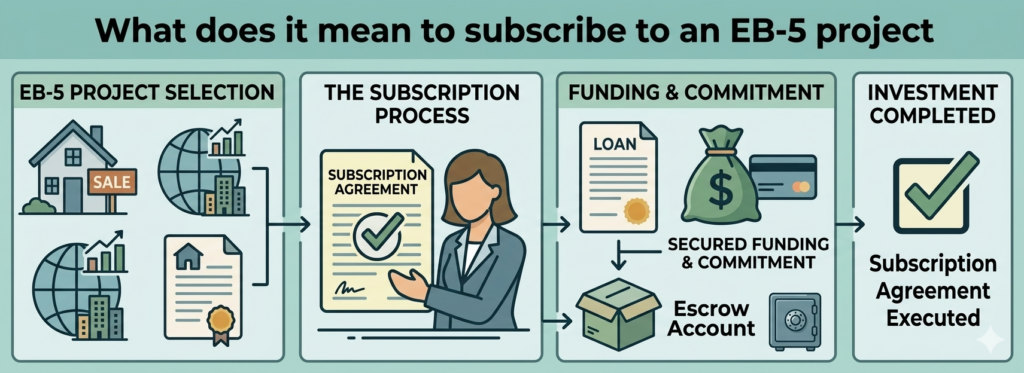
In simple terms, subscribing means applying to purchase an ownership interest in the EB-5 project’s new commercial enterprise, commonly called the NCE.
The investor reviews the offering documents, signs the required agreements, provides identity and compliance information, and agrees to contribute the required investment capital and related fees. Once the subscription is accepted, the investor is normally admitted as a limited partner or LLC member in the NCE.
What Are You Actually Investing In?
In most regional center projects, an EB-5 investor does not invest directly in the hotel, apartment development, factory, or other physical project.
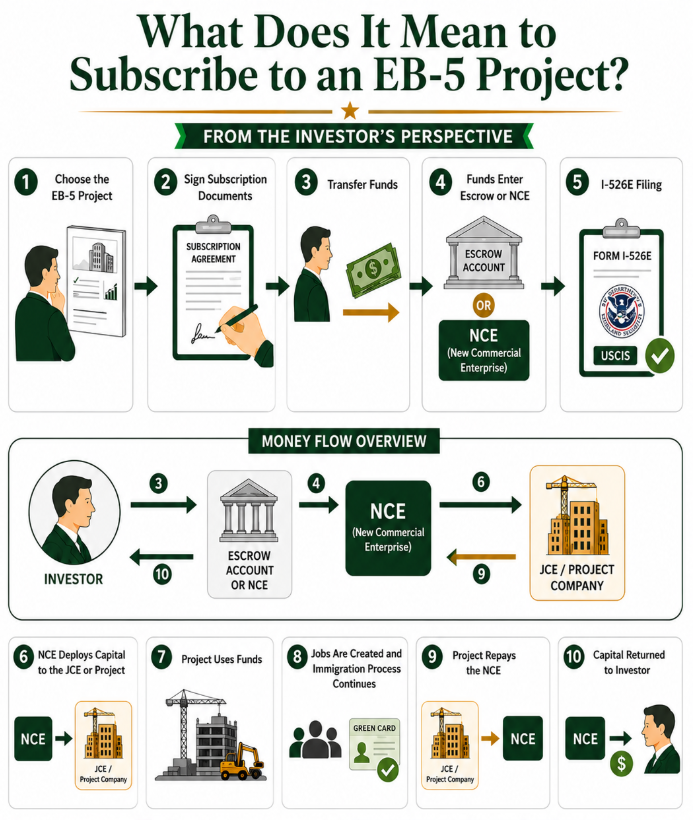
Instead, the investor normally purchases an interest in an NCE established to pool EB-5 capital. The NCE then provides the capital to the job-creating entity, commonly known as the JCE, through a loan or equity investment.
For example, the structure may look like this:
EB-5 Investor → NCE → JCE → Project
The investor may become a limited partner in a limited partnership or a member of a limited liability company. The investor generally has limited voting or policy-making rights but does not manage construction or daily project operations.
This distinction is important. When you subscribe, you are purchasing an ownership interest in the NCE—not purchasing part of the building itself.
What Is the Subscription Agreement?
The subscription agreement is the main document through which the investor applies to join the NCE.
It commonly includes:
- The investor’s name and personal details;
- The amount of capital being invested;
- The interest being purchased in the NCE;
- The project administrative fee;
- Investor representations and certifications;
- Conditions for accepting the subscription;
- Compliance and eligibility requirements; and
- Refund or rejection provisions.
By signing the agreement, the investor may confirm that they received the offering documents, understand the disclosed risks, meet the offering’s eligibility requirements, and are voluntarily making the investment.
However, signing does not always mean that the investor has already been formally accepted. The NCE manager may still need to review the documents, complete compliance checks, receive the funds, and countersign the agreement.
Investors should therefore ask for written confirmation that their subscription has been accepted and that they have been admitted to the NCE.
Subscription Is Not the Same as Reserving a Place
Some EB-5 projects allow investors to reserve a position before completing the full subscription process.
A reservation may temporarily hold an investor place, especially when a project has a limited number of available units. However, it is not always legally the same as subscribing.
A completed subscription may require the investor to:
- Review the project documents;
- Sign the subscription agreement;
- Complete investor questionnaires;
- Provide identification and compliance records;
- Pay the administrative fee;
- Transfer the investment capital; and
- Receive formal acceptance from the NCE.
A verbal confirmation, reservation form, or small deposit may not make the investor a legal member of the NCE. Investors should check exactly when the subscription becomes binding.
What Documents Will You Usually Receive?
Before subscribing, an investor normally receives an offering package containing several important documents.
Private Placement Memorandum
The Private Placement Memorandum, or PPM, explains the investment offering, project structure, use of funds, principal parties, potential conflicts, and major financial and immigration risks.
Subscription Agreement
This is the agreement used to apply for an interest in the NCE.
Operating or Partnership Agreement
This document explains how the NCE is managed, what voting rights investors have, how distributions may be made, and what happens when the investment is eventually exited.
Business Plan
The business plan describes the project, development schedule, business model, budget, market assumptions, and activities expected to create jobs.
Economic Report
For regional center projects, an economic report normally explains how the project expects to create the required number of jobs.
Escrow Agreement
When escrow is used, this agreement explains where the investment capital will initially be held and the conditions under which it may be released.
Loan or Equity Agreement
This document explains how the NCE will provide EB-5 capital to the JCE and how the NCE may later receive repayment or investment proceeds.
Why Must Investors Complete Questionnaires?
Most regional center EB-5 offerings are structured as private securities offerings. During subscription, investors may need to complete questionnaires covering:
- Income and net worth;
- Investment experience;
- Citizenship and residence;
- Tax status;
- Source of funds;
- Sanctions and anti-money-laundering information; and
- Eligibility under the securities exemption used by the offering.
Some investors may also be asked to confirm that they qualify as accredited investors. The exact requirement depends on how the securities offering has been structured and where it is being offered.
These forms should not be treated as routine paperwork. The investor should make sure every answer is accurate and consistent with the immigration petition, banking records, tax information, and source-of-funds documents.
Does Signing Complete the Investment?
Not necessarily.
Signing the subscription agreement is only one stage. The subscription may remain subject to:
- Acceptance by the NCE;
- Completion of compliance checks;
- Payment of the administrative fee;
- Receipt of the investment capital;
- Satisfaction of escrow conditions; or
- Other requirements stated in the offering documents.
Investors should request confirmation showing that the subscription has been accepted, the capital has been received, and the investor has been formally admitted as a member or limited partner.
These records may later be included in the investor’s Form I-526E filing.
When Can the Project Use Your Money?
The answer depends on the written escrow and offering documents.
Some projects may release capital after the investor files Form I-526E. Others may wait for a USCIS receipt notice, a minimum number of subscriptions, or another stated condition. Some projects may allow funds to be deployed before the investor’s I-526E is approved.
Before signing, investors should ask:
- Where will my money be held?
- Who controls the account?
- When can the funds be released?
- Can the project use my money before I-526E approval?
- What happens if my petition is denied?
- Which fees are refundable?
- What deductions may be made from a refund?
The answers should appear in the agreements rather than exist only in a sales presentation or verbal promise.
Can You Withdraw After Subscribing?
Withdrawal rights vary from project to project.
An investor may be allowed to withdraw before the NCE accepts the subscription, but cancellation may become more difficult after acceptance or deployment of the capital. EB-5 interests are generally private and illiquid, so investors may not be able to sell or transfer them freely.
The documents may also require approval from the NCE manager before an interest can be transferred.
Investors should therefore understand the cancellation, refund, and transfer provisions before signing. They should also discuss whether withdrawal could affect the immigration petition.
Questions to Ask Before Subscribing
Before making the commitment, I usually suggest that investors ask:
- What entity am I investing in?
- What ownership interest will I receive?
- Who manages the NCE?
- How will the NCE use my capital?
- Has Form I-956F been filed for the project?
- When will my subscription be accepted?
- When can my money leave escrow?
- What happens if my I-526E is denied?
- Is the administrative fee refundable?
- Can I withdraw or transfer my interest?
- How will project updates be provided?
- What are the main financial and immigration risks?
Final Thoughts
Subscribing to an EB-5 project means much more than filling out a form or reserving an investor position. It is the stage where the investor formally agrees to join the NCE, purchase a private ownership interest, contribute capital, and accept the rights and risks described in the offering documents.
After helping many families through the EB-5 process, my practical advice is simple: do not treat subscription documents as standard paperwork that only needs a signature.
Review the PPM, subscription agreement, operating or partnership agreement, escrow terms, and refund provisions together. Understand what you are purchasing, when your capital can be deployed, and what happens if the immigration or investment outcome is different from what you expect. The subscription stage is where project research becomes a real legal and financial commitment. Taking time to understand it before signing is much easier than trying to correct a misunderstanding after the funds have already been invested.