
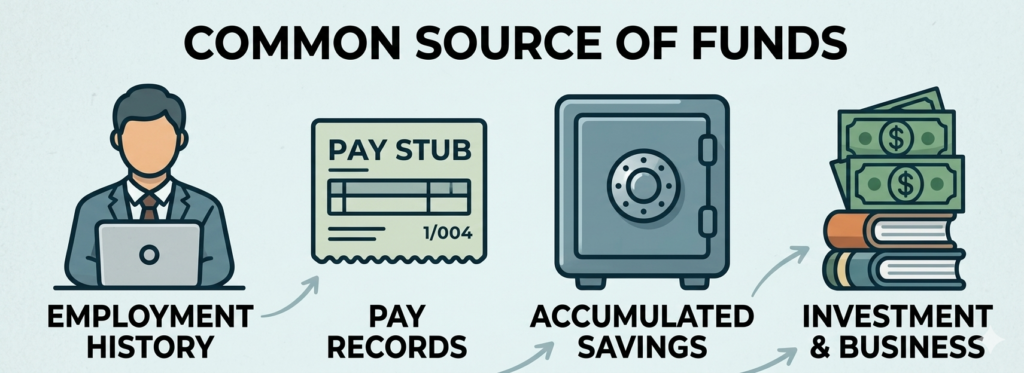
What Does “Source of Funds” Mean in EB-5?
Source of funds refers to the lawful origin of the money used for the EB-5 investment and related project expenses.
The money may come from salary savings, business income, company dividends, a property sale, investment income, a gift, an inheritance, or a properly documented loan. The source itself can vary significantly from one investor to another.
The important point is that the investor must be able to show that the capital was obtained through lawful means.
USCIS may need to understand not only the immediate account from which the investment was transferred, but also how the money was originally earned or acquired.
1. Salary, Bonuses, and Personal Savings
Salary savings are one of the most straightforward sources when the investor has a long and well-documented employment history.
For example, an investor may have worked as an executive, doctor, engineer, financial professional, or senior manager for many years and gradually accumulated enough savings for the EB-5 investment.
Documents may include:
- Employment contracts;
- Employer confirmation letters;
- Salary slips;
- Personal tax returns;
- Bank statements;
- Bonus records; and
- Evidence showing the accumulation of savings over time.
The main challenge is usually proving that the income was sufficient to support the amount invested after normal living expenses.
For investors who earned income over many years, old bank statements may no longer be available. In that situation, the immigration attorney may use tax records, employment history, salary records, and other supporting evidence to build a clear explanation.
2. Business Income and Company Dividends
Many EB-5 investors are business owners. Their funds may come from company profits, dividends, shareholder distributions, management compensation, or the sale of a business interest.
This type of case usually requires evidence showing two things:
First, the company earned the money lawfully. Second, the investor was legally entitled to receive it.
Supporting documents may include:
- Company registration records;
- Shareholding certificates;
- Business licenses;
- Corporate tax returns;
- Audited financial statements;
- Dividend resolutions;
- Company bank statements; and
- Personal bank statements showing receipt of the payment.
One common mistake is showing only that the investor received money from a company. USCIS may also want to understand how the company generated those funds.
For example, if a company pays a large dividend, the records should show that the company had sufficient lawful profits and that the distribution was properly authorized.
3. Proceeds From the Sale of Property
Property sale proceeds are one of the most common EB-5 funding sources, particularly for investors who have built wealth through residential or commercial real estate.
The investor may need to provide evidence such as:
- The original property purchase agreement;
- Ownership certificates;
- Mortgage documents;
- The property sale agreement;
- Tax payment records;
- Bank statements showing receipt of the sale proceeds; and
- Evidence showing how the property was originally acquired.
That final point is important. USCIS may not only ask where the sale proceeds came from. It may also ask how the investor originally purchased the property. If the property was bought many years ago, some original documents may be missing. This does not automatically make the case impossible, but the attorney may need to use secondary evidence, historical tax records, bank records, or a detailed explanation.
4. Gifts From Parents or Other Family Members
Gifted funds are very common in EB-5, especially when parents provide investment capital to an adult child.
A genuine gift can be used, but the gift does not remove the source-of-funds requirement. Instead, USCIS usually looks at the donor’s financial history.
For example, if parents gift $800,000 to their child, the parents may need to show whether that money came from salary, business income, property sales, investment income, or another lawful source.
The case may include:
- A gift agreement or gift declaration;
- Proof of the family relationship;
- The donor’s source-of-funds documents;
- Bank statements showing the transfer; and
- Confirmation that the money does not need to be repaid.
Current Form I-526E instructions specifically require investors using gifted or loaned funds to identify the donor or lender and provide supporting documentation showing that the transfer was genuine and not structured to avoid the lawful-source rules.
5. Loan Proceeds
Loan proceeds may also be used for EB-5 when the loan is lawful and properly documented.
A loan may come from a bank, financial institution, company, friend, or relative. However, different loan structures may create different documentation requirements.
Supporting evidence may include:
- The loan agreement;
- Repayment terms;
- Interest rate;
- Security or collateral documents;
- Evidence of the lender’s identity;
- Evidence showing the lender’s lawful source of funds; and
- Bank records tracing the loan proceeds.
For a bank loan secured by the investor’s property, USCIS may review the property ownership, valuation, mortgage, and loan disbursement.
For a private loan from a relative, USCIS may also ask how the relative obtained the money used for the loan.
Investors should review any loan structure with an experienced immigration attorney before accepting or transferring the funds.
6. Investment Income
Some investors use income or proceeds from stocks, bonds, mutual funds, private equity, cryptocurrency, or other investments.
The investor may need to show:
- How the original investment capital was obtained;
- When the investment was made;
- Ownership of the investment account;
- Trading or transaction history;
- Sale or liquidation records;
- Tax treatment; and
- Bank statements showing receipt of the proceeds.
For example, selling shares for a profit may create a lawful source, but USCIS may still want to know how the investor originally obtained the money used to buy those shares.
Cryptocurrency cases can be more complicated because investors may need to provide exchange records, wallet histories, transaction records, tax evidence, and proof of control over the relevant accounts or wallets.
7. Inheritance
Inherited assets or money may also be used for EB-5.
Typical records may include:
- A will;
- Probate documents;
- A death certificate;
- Estate distribution records;
- Court documents;
- Tax records; and
- Bank statements showing the inheritance transfer.
Older inheritances can sometimes be difficult to document, particularly if the funds were received many years ago or if the country did not maintain detailed estate records.
In those cases, the petition may rely on the best available evidence together with a detailed written explanation.
8. Sale of Stocks, Business Interests, or Other Assets
An investor may sell company shares, partnership interests, securities, vehicles, artwork, or other valuable assets.
This type of funding source usually requires evidence of:
- Original ownership;
- Original acquisition;
- Sale price;
- Buyer information;
- Sale agreement;
- Taxes; and
- Receipt of proceeds.
The principle is the same as with a property sale: USCIS may want to understand both how the asset was acquired and how the sale generated the EB-5 capital.
9. Divorce Settlements or Legal Awards
Some investors receive funds through divorce settlements, court judgments, or legal compensation.
Documents may include:
- Divorce agreements;
- Court orders;
- Settlement agreements;
- Judgment records;
- Payment evidence; and
- Bank statements.
The legal documents should clearly establish the investor’s right to receive the funds.
10. Combining More Than One Source
Many investors do not use just one source.
For example, an EB-5 investment may be funded through:
- $300,000 from salary savings;
- $250,000 from a property sale;
- $150,000 from investment income; and
- $100,000 gifted by parents.
Using several sources is possible, but each source must be separately documented and traced.
In my experience, combining too many sources can make the petition more complicated. When investors have several options, I usually suggest choosing the sources with the clearest documentation rather than using every available asset.
Which Source of Funds Is Best?
There is no universally “best” source of funds.
The strongest source is generally the one that is:
- Lawful;
- Clearly owned by the investor or properly gifted or loaned;
- Supported by reliable documents;
- Easy to trace through bank records; and
- Consistent with the investor’s financial history.
A property sale is not automatically better than salary savings. A gift is not automatically easier than business income. A loan is not automatically more difficult than an inheritance.
The quality of the documentation matters more than the name of the category.
Final Thoughts
Choose the most documentable source, not only the most convenient source.
Before moving money, ask your immigration attorney to review the proposed funding structure. Once the funds have passed through several accounts, relatives, currencies, or countries, correcting the path can become much more difficult.
Your financial history does not need to be simple. But every part of the EB-5 capital should have a clear origin, a traceable path, and credible supporting evidence.