
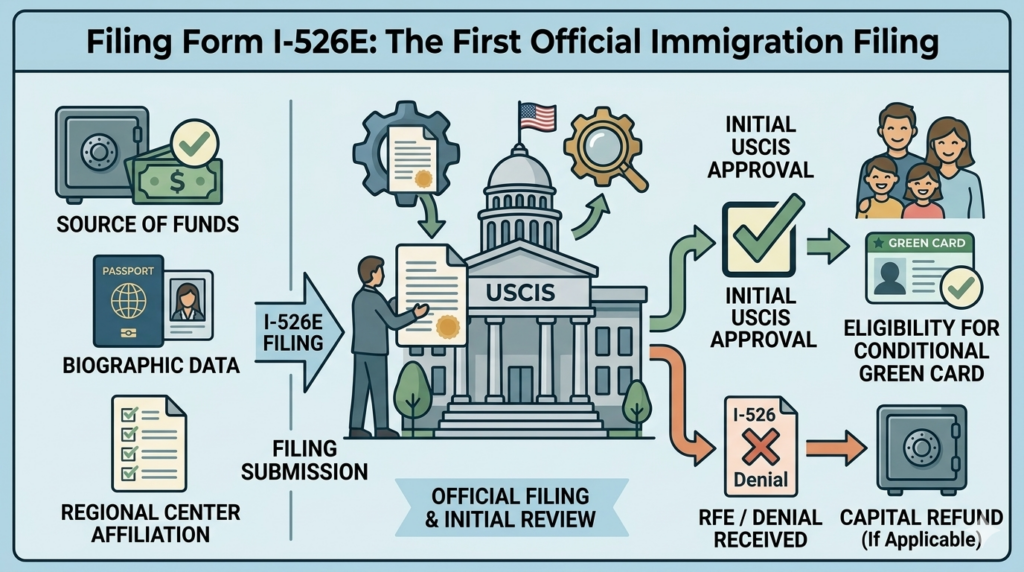
After working with EB-5 investors and their families for more than 10 years, I have found that filing Form I-526E is often the moment when the EB-5 process begins to feel real.
Before this stage, the investor may have spent months learning about EB-5, comparing projects, preparing source-of-funds documents, signing subscription agreements, and transferring the investment capital. These are all essential steps, but they mainly involve preparation and investment.
Form I-526E is the investor’s first formal immigration petition submitted to U.S. Citizenship and Immigration Services, or USCIS, under the regional center program.
What Is Form I-526E?
Form I-526E is called the Immigrant Petition by Regional Center Investor.
It is used by investors who pool their capital with other investors through the EB-5 regional center program. Most investors participating in regional center projects file Form I-526E rather than Form I-526.
Form I-526 is used for standalone investors who are not investing through a regional center. Although the names are similar, the forms should not be confused.
In simple terms:
- Regional center investor: Form I-526E
- Standalone or direct investor: Form I-526
The purpose of Form I-526E is to show that the investor has made, or is actively in the process of making, a qualifying EB-5 investment and meets the personal requirements of the program.
Why Is I-526E the First Official Immigration Filing?
Before I-526E is submitted, the investor may already have signed legally binding investment documents and transferred a significant amount of money. However, USCIS has not yet received the investor’s individual immigration petition.
The I-526E filing formally introduces the investor’s case to USCIS.
Once the petition is properly accepted, USCIS issues a receipt notice. The filing date generally establishes the investor’s priority date, which may later become important when determining immigrant visa availability.
However, filing I-526E does not itself grant a green card, lawful immigration status, work authorization, or permission to enter the United States.
It begins the immigrant petition stage. The investor must still complete the later green card process through adjustment of status in the United States or consular processing abroad, depending on eligibility and location.
What Must Happen Before I-526E Can Be Filed?
A regional center investor cannot normally file Form I-526E before the sponsoring regional center submits Form I-956F for the relevant project.
Form I-956F is the project-level application. It includes information about the investment offering, new commercial enterprise, job-creating project, business plan, economic report, and other project documents.
I usually explain the relationship this way:
- Form I-956F is the project’s application.
- Form I-526E is the investor’s petition.
The regional center must file the project application first. Once that filing has been made, associated investors may generally proceed with their individual I-526E petitions.
The I-956F does not necessarily need to be approved before the investor files I-526E. However, USCIS normally makes an official decision on the project application before deciding the associated investor petitions.
Investors should therefore confirm that Form I-956F has been filed and obtain the project receipt information needed for their I-526E package.
What Does USCIS Review in an I-526E Petition?
An I-526E petition brings together two main parts of the EB-5 case:
- The investor’s personal eligibility; and
- The investor’s participation in the qualifying regional center project.
On the personal side, USCIS may review whether the investor:
- Invested or is actively in the process of investing the required capital;
- Obtained the investment capital through lawful means;
- Can trace the complete path of funds into the investment;
- Properly subscribed to the new commercial enterprise;
- Meets the relevant identity and admissibility-related requirements; and
- Provided accurate and consistent information.
On the project side, USCIS considers whether the investment is connected to a properly filed regional center project that is expected to meet EB-5 requirements, including job creation.
Although the regional center provides most of the project-level documents, the investor remains responsible for submitting a complete personal petition.
What Documents Are Commonly Included?
Every I-526E petition is different, but a filing package may include several major document groups.
Personal and Family Documents
These may include passports, birth certificates, marriage certificates, evidence of current immigration status, and information about the investor’s spouse and children.
Family members are normally listed in the petition, but they do not each file a separate I-526E. They later apply for their own green cards as derivative beneficiaries if they remain eligible.
Source-of-Funds Evidence
This is often the largest part of the petition.
The investor may need documents showing salary savings, business income, company dividends, property sale proceeds, gifts, loans, inheritance, or investment income.
USCIS may review not only the immediate source of the money but also how the underlying asset or wealth was originally acquired.
Path-of-Funds Evidence
Bank statements, wire records, foreign-exchange documents, remittance receipts, and escrow confirmations may be used to show how the capital moved into the EB-5 investment.
Every material transfer should be understandable and supported.
Subscription and Investment Documents
These may include:
- The subscription agreement;
- Operating or limited partnership agreement;
- Proof of admission into the NCE;
- Investment wire confirmation;
- Administrative-fee payment records; and
- Confirmation that the project received the funds.
Project Documents
The project team normally provides the relevant offering and project materials, which may include the PPM, business plan, economic report, organizational documents, and I-956F filing information.
Does the Full Investment Have to Be Transferred Before Filing?
The law refers to an investor who has invested or is actively in the process of investing the required capital.
However, the exact funding structure should be reviewed carefully with the immigration attorney. Many regional center investors fully transfer the required investment before filing because this creates clear evidence that the capital has been committed.
Some projects may allow partial funding or installment arrangements, but these structures can create additional legal and evidentiary questions. The investor must still show a genuine and enforceable commitment to invest the full qualifying amount.
Investors should not assume that signing a subscription agreement without transferring capital is always enough.
What Happens After Filing?
After USCIS accepts the petition, it issues Form I-797, Notice of Action, commonly called the receipt notice.
The receipt notice normally includes:
- The investor’s name;
- The form type;
- The receipt number;
- The date USCIS received the filing; and
- The petition’s priority date.
The receipt number can be used to monitor the case through USCIS case-status tools.
The receipt notice is not an approval. It only confirms that USCIS accepted the petition for processing.
After filing, USCIS may:
- Approve the petition;
- Issue a Request for Evidence;
- Issue a Notice of Intent to Deny;
- Deny the petition;
- Request an interview in unusual circumstances; or
- Hold the investor petition while the related I-956F is being adjudicated.
Processing times vary, and no responsible advisor should promise an exact approval date.
Can USCIS Ask for More Evidence?
Yes. USCIS may issue a Request for Evidence, commonly called an RFE, when it believes additional documents or explanations are needed.
An RFE may involve:
- Missing source-of-funds records;
- Unexplained bank transactions;
- Inconsistencies in business or tax documents;
- Questions about a gift or loan;
- Missing identity or family records;
- Investment-transfer issues; or
- Project-related questions.
Receiving an RFE does not automatically mean the petition will be denied. It means USCIS wants more information before making a decision.
However, the response must be prepared carefully and submitted within the stated deadline.
Common Mistakes to Avoid
One common mistake is rushing to file simply because a project position may be limited.
Another is transferring the investment before the proposed source and path of funds have been reviewed. Once the money has moved through several accounts or family members, missing records may be difficult to recover.
Other common problems include:
- Using inconsistent names or dates across documents;
- Failing to document the administrative fee;
- Assuming project approval guarantees personal approval;
- Confusing the receipt notice with an approval notice;
- Omitting family members from the petition;
- Relying only on summaries instead of primary financial documents; and
- Filing before confirming that the regional center submitted Form I-956F.