
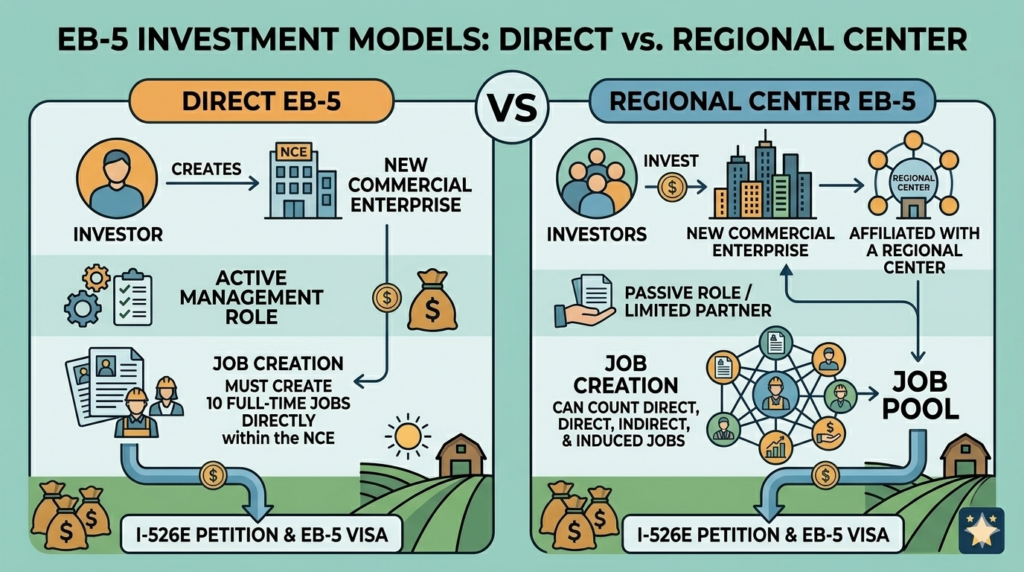
First of all, both regional center projects and direct project can potentially lead to U.S. permanent residence, but they are very different in practice. One usually suits investors who want a more passive role, while the other is generally more suitable for entrepreneurs who want to build and operate their own U.S. business.
What Is Direct EB-5?
Direct EB-5, usually involves investing directly in a new commercial enterprise that creates the required jobs.
For example, an investor may establish or expand a restaurant, manufacturing company, franchise, healthcare business, technology company, or another operating business in the United States.
The investor files Form I-526 as a standalone investor. The business must generally create at least 10 qualifying full-time jobs for U.S. workers for each EB-5 investor. In direct EB-5, job creation is usually based on actual employees working for the business. These must generally be qualifying full-time positions, rather than independent contractors or part-time roles combined together.
The main advantage of direct EB-5 is control. The investor may decide how the business is operated, where the capital is used, which employees are hired, and how the company grows. However, control also brings responsibility. The investor must make sure the business performs well enough to continue operating and create the required jobs. If the business struggles, closes, or fails to hire enough qualifying employees, both the investment and immigration case may be affected.
What Is Regional Center EB-5?
Regional center EB-5 is usually a more passive investment route.
The investor places capital into a new commercial enterprise associated with a USCIS-designated regional center. The new commercial enterprise then normally invests or loans the pooled EB-5 capital into a job-creating project. These projects may include hotels, apartment developments, manufacturing facilities, senior housing, energy projects, infrastructure, or other large developments.
The investor generally becomes a limited partner or a member of an LLC. The investor may have certain voting or policy rights, but normally does not manage construction, hire employees, or operate the project on a daily basis.
A regional center investor files Form I-526E rather than the standalone Form I-526.
One of the most important differences is job creation. Regional center projects may count not only direct jobs but also indirect jobs supported by project spending and economic activity. Under current USCIS rules, up to 90% of the job-creation requirement for a regional center investor may be met through indirect jobs. This makes regional center investments more practical for investors who do not want to personally operate a U.S. company or manage 10 full-time employees.
Comparison
Area | Direct EB-5 | Regional Center EB-5 |
| Investor role | Usually active | Usually passive |
| Main filing | Form I-526 | Form I-526E |
| Business control | Generally higher | Generally limited |
| Job creation | Mainly direct employees | Direct and indirect jobs may count |
| Capital structure | Usually one operating business | Often a pooled project structure |
| Best suited for | Entrepreneurs and operators | Passive investors and families |
| Main challenge | Running the business and creating jobs | Selecting a strong project |
| Key risk | Business performance | Project, developer, repayment, and compliance risk |
When Direct EB-5 May Be Suitable
Direct EB-5 may be worth considering when you genuinely want to establish and manage a business in the United States.
It may fit investors who:
- Have strong business or operational experience;
- Already have a clear and realistic U.S. business plan;
- Want more control over how the capital is used;
- Are comfortable hiring and managing employees;
- Intend to spend significant time operating the business; and
- Understand that job creation depends heavily on business performance.
In my experience, direct EB-5 should not be selected only because the investor believes having more control means having less risk. Running a new business in the United States can be demanding. The investor must consider local competition, employment law, taxes, licensing, operating costs, and customer demand.
A direct investment may offer control, but it also concentrates responsibility in the investor’s hands.
When Regional Center EB-5 May Be Suitable
Regional center EB-5 is generally more suitable for investors whose main goal is immigration rather than operating a business.
It may fit investors who:
- Want a more passive investment structure;
- Do not want to manage a U.S. company daily;
- Prefer professional project management;
- Want to rely on a project-level economic model for job creation;
- Are planning mainly around family immigration or children’s education; and
- Are comfortable holding a limited management role.
Many of the investors I have worked with already have businesses, jobs, or family responsibilities outside the United States. They do not want to relocate immediately to manage a restaurant, factory, or franchise. For these families, regional center EB-5 is often more practical.
However, passive does not mean risk-free. The investor still needs to review the project carefully.
What Risks Should Regional Center Investors Review?
A regional center designation is NOT a government guarantee. It does not guarantee I-526E approval, successful job creation, project completion, or capital repayment.
Before choosing a regional center project, investors should review:
- The regional center’s history and role;
- The developer’s track record;
- Whether Form I-956F has been filed or approved;
- The project business plan;
- The economic report and job-creation cushion;
- The amount of developer equity;
- The project’s senior debt and capital stack;
- Construction progress;
- The repayment source; and
- The planned exit strategy.
The regional center may support EB-5 compliance, but the developer and job-creating entity are usually responsible for completing and operating the actual project. Understanding who is responsible for each part is essential.
Does One Option Have Lower Immigration Risk?
It is difficult to say that one structure is automatically safer.
In direct EB-5, the investor has more control but also carries more responsibility for job creation and business performance.
In regional center EB-5, job creation may be easier to document because indirect jobs can count. However, the investor depends more heavily on the regional center, developer, project manager, and other parties.
The real question is not simply which model has lower risk. It is which type of risk you are better prepared to understand and manage.
Final Thoughts
When investors ask me whether regional center or direct EB-5 is better, I usually ask them one practical question:
Do you genuinely want to operate a U.S. business, or is your main goal to obtain permanent residence through a more passive investment?
If you have a strong business plan, want control, and are ready to manage employees and operations, direct EB-5 may be suitable.
If your priority is family immigration and you prefer not to run a U.S. business, regional center EB-5 may be more practical.