
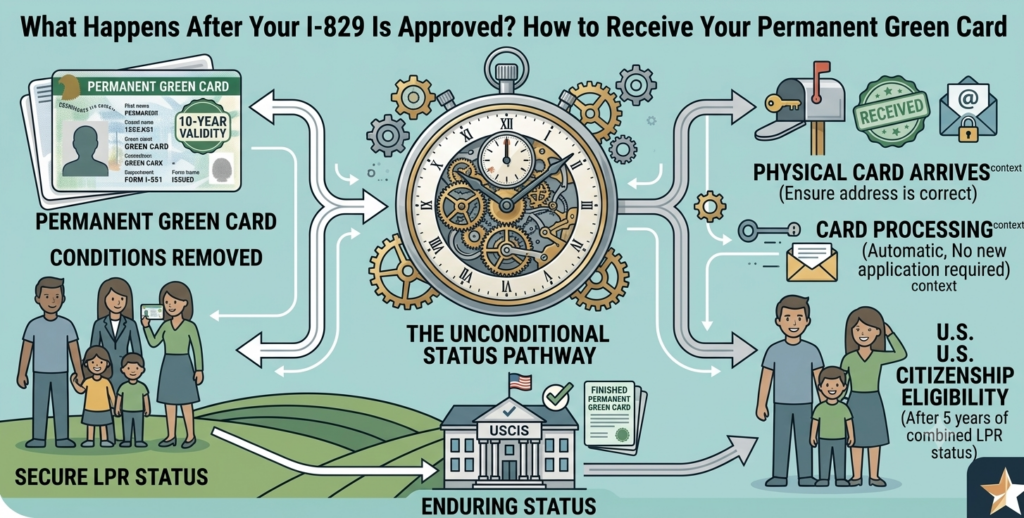
Investors often ask one practical question after approval: “What do I need to do next to get my green card?” . The answer is usually simple, but there are still important details to check.
1. Understand What I-829 Approval Means
When USCIS approves Form I-829, the investor and included family members are no longer conditional permanent residents. The EB-5 conditions are removed, and they become lawful permanent residents without the two-year EB-5 condition. This does not mean the person is becoming a U.S. citizen. It means the conditional green card stage has ended and the person should receive a regular permanent resident card.
The new card is commonly called a 10-year green card because it is normally valid for 10 years. The status itself is permanent resident status, but the physical card must still be renewed in the future if it expires. I usually explain it this way: I-829 approval removes the EB-5 condition. The new green card is the document that proves your updated permanent resident status.
2. Wait for the I-829 Approval Notice
The first document investors usually receive is the I-829 approval notice from USCIS.
This approval notice is very important. Keep both a digital copy and a paper copy. It may be needed later for card issues, travel questions, naturalization, or immigration-record correction.
If the investor has family members included in the I-829 petition, each family member may receive their own approval information, or the approval may reference included dependents depending on the case.
After approval, USCIS normally begins the process of producing the new green card. In many cases, the investor does not need to file a separate application just to receive the new card.
3. Check Your Mailing Address Immediately
One of the most practical things investors should do after I-829 approval is confirm that USCIS has the correct mailing address.
USCIS mails cards to the address of record. If the address is wrong, outdated, incomplete, or not secure, the card may be delayed, returned, or lost.
If you moved during the I-829 process, make sure your attorney updated the address correctly. You should also confirm whether the approval notice was sent to your attorney, your home address, or both.
USCIS provides tools for people who do not receive a card after approval, including a non-delivery of card service request. USCIS states that once it approves an immigration benefit for which a card is issued, it will mail the card to the address of record. (uscis.gov)
4. Watch for the Physical Green Card
After I-829 approval, the physical permanent resident card should be produced and mailed.
When the card arrives, check it carefully. Review:
- Full legal name;
- Date of birth;
- Country of birth;
- Alien Registration Number;
- Card category;
- Resident Since date;
- Card expiration date;
- Spelling and formatting.
The Resident Since date should generally reflect when the person first became a conditional permanent resident, not the date the I-829 was approved. This date can be important for future naturalization planning. The new expiration date should generally be 10 years from card issuance, but the exact card details should always be reviewed carefully.
If there is an error on the card, contact your immigration attorney promptly. Depending on the issue, a correction process may be needed.
5. What If the Card Does Not Arrive?
If the approval notice arrives but the physical card does not arrive within a reasonable time, do not ignore it.
First, confirm the mailing address. Then check whether USCIS has issued a card-production notice or tracking information. If the card appears to have been mailed but never received, you may need to submit a service request for non-delivery.
If the card was lost, stolen, damaged, or issued with incorrect information, the investor may need to file Form I-90 to replace or renew the Permanent Resident Card. USCIS states that Form I-90 is used to replace a Permanent Resident Card, but conditional permanent residents who obtained status through investment should not use I-90 to remove conditions; they use I-829 for that purpose. (uscis.gov)
After I-829 is approved and the conditions are removed, I-90 may become relevant only if the permanent resident card needs replacement, renewal, or correction.
6. Keep Proof of Status While Waiting
Sometimes there may be a gap between I-829 approval and physical card delivery.
During that period, keep the following documents accessible:
- Expired conditional green card;
- I-829 receipt notice showing extension of status;
- I-829 approval notice;
- Passport;
- Any USCIS appointment notices or temporary evidence of status.
USCIS previously updated receipt notices for Form I-829 to extend status for 48 months beyond the card’s expiration date while the petition is pending. (uscis.gov)
Once I-829 is approved, the approval notice becomes the key proof that the conditions were removed, but the physical green card is still the main everyday document for work, travel, and identification.
If you need to travel urgently or prove status before the new card arrives, speak with your attorney about whether you need temporary evidence of permanent resident status.
7. Do Family Members Also Receive New Cards?
Yes, family members included in the I-829 approval should also receive updated green cards with conditions removed.
However, families should check each person’s card separately.
Do not assume every card is correct just because the principal investor’s card is correct. Each family member has their own immigration record, card production, mailing process, and personal information.
This is especially important if a spouse or child received conditional residence on a different date, lived at a different address, or had a separate immigration issue during the process.
8. Does I-829 Approval Mean You Can Stop Tracking EB-5 Completely?
From an immigration perspective, I-829 approval is usually the end of the EB-5 condition-removal process.
However, investors should still keep important EB-5 records permanently, including:
- I-526E approval notice;
- Conditional green cards;
- I-829 filing copy;
- I-829 approval notice;
- New permanent green card copies;
- Project documents;
- Tax documents;
- Capital-return records;
- Communications about repayment.
These documents may be useful for naturalization, tax review, future immigration questions, or explaining the history of permanent residence.
If the EB-5 investment has not yet been repaid, the investor should continue following project communications as an investor, even though the immigration conditions have been removed.
9. What About Capital Return?
I-829 approval does not automatically mean your EB-5 capital will be returned immediately.
Capital return depends on the project documents, loan maturity, exit strategy, repayment source, redeployment terms, and project performance. USCIS approval removes the immigration conditions, but it does not force the project to repay on the same date.
This is a common misunderstanding. Investors sometimes think:
“My I-829 is approved, so I should get my money back now.”
In reality, these are two separate issues:
- I-829 approval: immigration condition removed.
- Capital return: governed by investment documents and project performance.
After I-829 approval, investors should review their subscription agreement, operating agreement, loan terms, and project updates to understand when repayment may occur.
10. Can You Apply for Citizenship After I-829 Approval?
Many investors also ask whether I-829 approval means they can apply for U.S. citizenship immediately.
The answer depends on whether they meet the naturalization requirements, including continuous residence, physical presence, good moral character, and the required period as a permanent resident.
In many cases, the time spent as a conditional permanent resident counts toward the permanent residence period for naturalization. The Resident Since date on the green card is therefore important.
However, naturalization timing depends on travel history, residence pattern, tax compliance, family situation, and other factors. It should be reviewed separately with an immigration attorney before filing Form N-400.
11. Practical Checklist After I-829 Approval
After receiving I-829 approval, investors should:
- Save the I-829 approval notice.
- Confirm USCIS has the correct mailing address.
- Watch for card-production and mailing updates.
- Check each family member’s card carefully.
- Report non-delivery if the card does not arrive.
- Correct any errors promptly.
- Keep EB-5 immigration records permanently.
- Continue tracking capital-return updates.
- Review naturalization planning if citizenship is a future goal.
- Speak with an attorney before major travel or status-related decisions.