
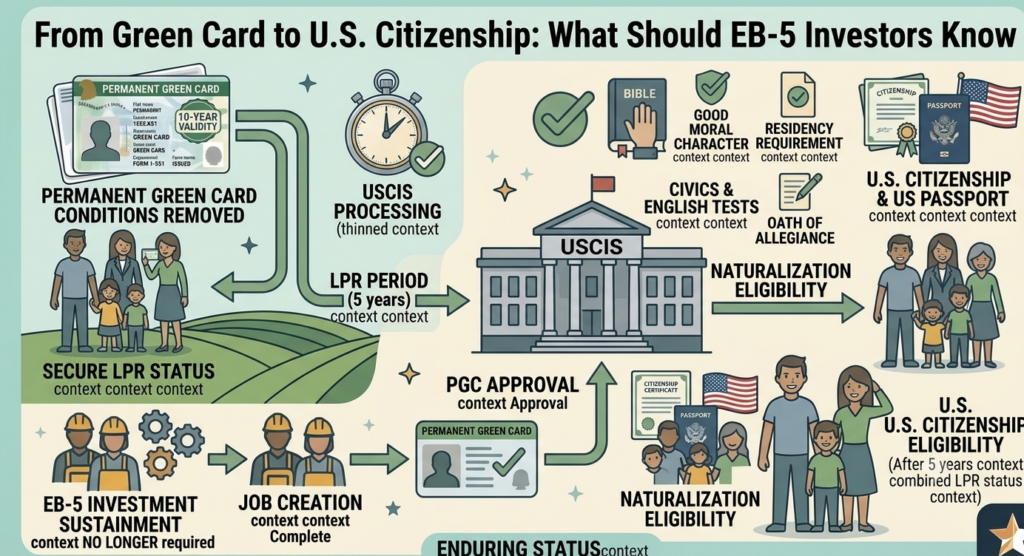
Citizenship Is Optional, Not Required
One common misunderstanding is that every green card holder must eventually become a U.S. citizen. That is not true.
Many lawful permanent residents keep their green cards for many years and never apply for naturalization. A green card allows a person to live and work permanently in the United States, but the person remains a citizen of another country.
Citizenship is a personal decision. It may affect taxes, passport rights, voting rights, family planning, estate planning, and whether the investor’s original country allows dual citizenship.
Before applying, EB-5 investors should think carefully about whether citizenship fits their family’s long-term goals.
When Can EB-5 Investors Apply for Citizenship?
Most EB-5 investors apply for naturalization under the general five-year permanent resident rule.
USCIS explains that a lawful permanent resident applying under the five-year rule must generally be at least 18 years old and have been a lawfully admitted permanent resident for at least five years before filing Form N-400. USCIS also allows many applicants to file up to 90 days before meeting the five-year residence requirement.
For EB-5 investors, an important point is that the time spent as a conditional permanent resident generally counts toward the five-year period.
This means the clock usually starts from the “Resident Since” date on the green card, not from the I-829 approval date.
For example, if an EB-5 investor became a conditional permanent resident on January 1, 2027, the five-year period would generally be counted from that date, even if the I-829 petition is approved later.
Investors should keep copies of their conditional green cards, I-829 approval notice, and new 10-year green card because these records may be useful when preparing the citizenship application.
Main Eligibility Requirements
Naturalization is not based only on holding a green card for five years.
Applicants generally need to meet several requirements, including continuous residence, physical presence, good moral character, English ability, and knowledge of U.S. history and government.
USCIS states that applicants under the five-year rule generally must show continuous residence in the United States for at least five years before filing. They must also show physical presence in the United States for at least 30 months during the five-year period.
For EB-5 investors, this is very important because many investors continue to travel internationally for business, family, or investment reasons after receiving the green card.
A green card is not simply a travel document. Permanent residents are expected to treat the United States as their permanent home.
Form N-400: The Citizenship Application
The application for naturalization is Form N-400.
USCIS describes Form N-400 as the application used by lawful permanent residents to apply for naturalization. USCIS also provides online filing through a USCIS online account.
The N-400 process generally includes:
- Preparing the application;
- Collecting supporting documents;
- Submitting the filing fee;
- Attending biometrics if required;
- Attending the naturalization interview;
- Completing the English and civics test unless exempt;
- Receiving a decision; and
- Taking the Oath of Allegiance if approved.
USCIS explains that the naturalization process includes submitting the application, attending biometrics, completing the interview and test, and taking the oath if approved.
The oath is the final step. A person does not become a U.S. citizen simply because the N-400 is filed or interview is completed. Citizenship begins after the oath is taken.
What About the English and Civics Test?
Most naturalization applicants must show basic ability to read, write, and speak English and must pass a civics test about U.S. history and government.
There are some exemptions and accommodations based on age, time as a permanent resident, and certain medical conditions, but investors should not assume an exemption applies automatically.
For many EB-5 families, the English and civics test is not the most difficult part. The more difficult part is often proving travel history, continuous residence, tax compliance, and clean immigration records.
Tax and Travel Planning Before Citizenship
Before applying for citizenship, investors should review both immigration and tax records.
Naturalization applicants may be asked about tax filing history, employment, addresses, travel outside the United States, and compliance with U.S. laws.
EB-5 investors often have assets, businesses, or family obligations in more than one country. This makes planning especially important.
Investors should keep:
- Copies of all green cards;
- Travel history and passport stamps;
- U.S. tax filings;
- Address history;
- Employment and business records;
- I-829 approval records;
- Selective Service records if applicable;
- Records of any arrests, citations, or legal issues.
Before filing N-400, it is wise to review the case with an immigration attorney, especially if the investor had long absences, frequent travel, late tax filings, criminal or civil issues, or any complications during the EB-5 process.