
What Is NCE?
NCE stands for New Commercial Enterprise.
In simple terms, the NCE is usually the entity that receives the EB-5 investor’s capital. When an investor joins an EB-5 project, they often become a limited partner or member of the NCE.
The NCE is important because it is the legal investment vehicle between the investor and the project. It may be structured as a limited partnership, limited liability company, or another business entity. The investor’s subscription agreement, offering documents, and investment rights are usually connected to the NCE.
In a regional center project, the investor usually does not invest directly into the construction company, hotel developer, senior living operator, or real estate project company. Instead, the investor invests into the NCE.
What Is JCE?
JCE stands for Job-Creating Entity.
The JCE is the entity that actually uses the EB-5 capital to develop, operate, or expand the project. It is called the “job-creating” entity because it is usually responsible for the business activity that creates the required EB-5 jobs.
For example, if the EB-5 project is a hotel development, the JCE may be the hotel development company. If the project is a senior living facility, the JCE may be the company constructing or operating that facility.
In many regional center projects, the NCE provides funding to the JCE through a loan or equity investment. The JCE then uses that money for construction, development, operations, or other project costs.
Key Differences Between NCE and JCE
| Item | NCE | JCE |
| Full Name | New Commercial Enterprise | Job-Creating Entity |
| Main Role | Receives EB-5 investor capital | Uses the capital to create jobs |
| Investor Relationship | Investor usually invests into the NCE | Investor usually does not invest directly into the JCE |
| Function | Investment vehicle | Project/business operator or developer |
| Common Structure | Fund or partnership | Real estate developer, operating company, or project company |
| Importance | Manages investor capital and legal investment structure | Responsible for project activity and job creation |
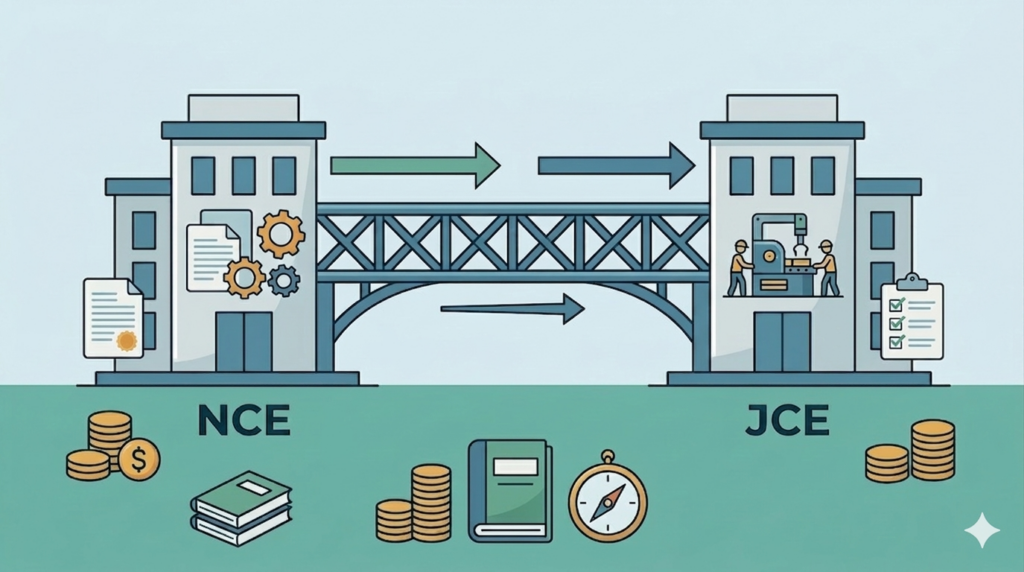
In a common regional center structure, investors place capital into the NCE. The NCE then loans or invests that money into the JCE. The JCE may be the developer, operating company, or project company responsible for construction and business activity.
Why does this matter? Because EB-5 investors need to understand where their money goes. The NCE may be the legal investment vehicle, but the JCE may be the entity responsible for using the money and creating the jobs required for immigration approval.
USCIS has emphasized compliance and integrity obligations for EB-5 entities, including regional centers, NCEs, and JCEs, especially after the EB-5 Reform and Integrity Act. Noncompliance by EB-5 entities can create serious consequences for projects and investors.
When reviewing a project, investors should ask: Who manages the NCE? Who controls the JCE? What agreement connects the NCE and JCE? Is the EB-5 capital a loan or equity investment? What rights does the NCE have if the JCE fails to perform?
Understanding NCE and JCE helps investors read offering documents more clearly. It also helps them understand job creation, repayment, and project control.