
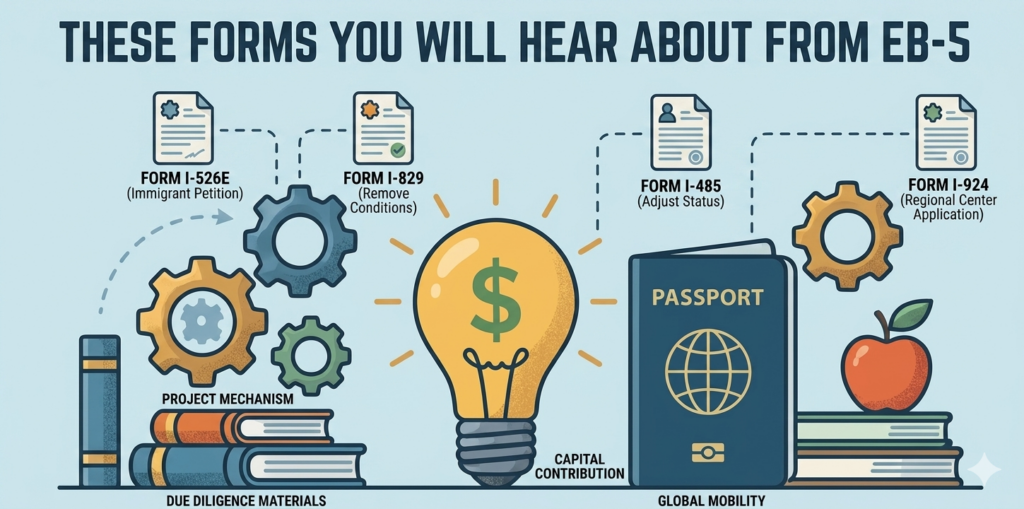
When investors first learn about EB-5, the number of immigration forms can feel overwhelming.You may hear forms such as I-956F, I-526E, I-485, DS-260, and I-829. Understanding this difference can help you follow your case more clearly and ask better questions throughout the EB-5 process.
| Form | Filed by | Main Purpose |
| I-956 | Regional center applicant | Applies for initial regional center designation or an amendment to an existing designation |
| I-956F | Designated regional center | Requests USCIS approval of a specific regional center investment offering |
| I-956G | Regional center | Provides the regional center’s required annual statement and compliance information |
| I-956H | Certain people involved with the regional center, NCE, JCE, or related entities | Provides identity, ownership, background, and eligibility information about people involved in the EB-5 entities |
| I-526E | Regional center investor | Establishes the investor’s eligibility under the regional center program |
| I-485 | Eligible investor and family members in the United States | Applies to adjust status to conditional permanent residence without completing immigrant visa processing abroad |
| DS-260 | Investor and family members completing the process outside the United States | Applies for an immigrant visa through consular processing |
| I-829 | Requests removal of the conditions on permanent residence | Requests removal of the conditions on permanent residence |
What Is Form I-956?
Form I-956 is used to apply for designation as an EB-5 regional center or to request certain amendments to an existing regional center designation.
A regional center is an organization designated by USCIS to sponsor investment offerings under the EB-5 Regional Center Program. Most individual investors will not file Form I-956 themselves.
From an investor’s perspective, this form helps answer a basic question:
Is the organization presenting itself as a regional center properly designated to participate in the EB-5 program?
Investors should not treat regional center designation as proof that a particular investment is financially safe. It only means the organization has received the relevant designation from USCIS.
What Is Form I-956F?
Form I-956F is one of the most important project-related forms for a regional center investor.
Before investors file their individual Form I-526E petitions, the regional center must generally submit Form I-956F for the specific investment offering. The filing includes information about the new commercial enterprise, the job-creating entity, the business plan, economic analysis, capital structure, job-creation methodology, and other offering documents.
In simple terms:
The I-956F is the project-level filing, while the I-526E is the investor-level filing.
An investor does not usually file the I-956F, but the investor should know whether it has been properly filed and should obtain the related receipt information through the project or legal team.
An I-956F filing or approval does not guarantee that every investor’s I-526E will be approved. USCIS still reviews each investor’s personal eligibility, lawful source of funds, transfer path, and other individual evidence.
What Is Form I-956G?
Form I-956G is the regional center’s annual statement.
It is used to provide USCIS with ongoing information about the regional center’s activities, sponsored investments, investors, job creation, compliance, and other required matters.
This is mainly a regional center compliance responsibility rather than an investor filing.
Investors may not see the full filing in their personal immigration package, but the form matters because a regional center must continue meeting its reporting and compliance obligations after investors have entered the project.
What Is Form I-956H?
Form I-956H provides information about certain people involved with the regional center program.
Depending on the entity and the person’s role, this may include individuals associated with the regional center, new commercial enterprise, job-creating entity, or other related organizations.
The form helps USCIS review matters such as:
- Identity and ownership;
- Management or decision-making authority;
- Business background;
- Criminal or regulatory history;
- Eligibility to participate in the regional center program.
Most EB-5 investors do not file Form I-956H merely because they invest in a regional center offering. It is generally associated with people who hold relevant ownership, management, control, or operational roles in covered EB-5 entities.
What Is Form I-526E?
Form I-526E is the main immigrant petition for an investor participating in a regional center project.
Through this petition, the investor generally needs to demonstrate that:
- The required investment has been made or is actively in the process of being made;
- The investment capital came from lawful sources;
- The path of the funds can be documented;
- The investor invested in a qualifying new commercial enterprise;
- The investment is expected to satisfy the applicable job-creation requirement;
- The investor meets the other requirements of the EB-5 program.
USCIS separates regional center investors from standalone investors: regional center investors use Form I-526E, while standalone investors use Form I-526.
The I-526E is not the green card application itself. It is the petition asking USCIS to recognize the investor as eligible for EB-5 immigrant classification.
What Is Form I-526?
Form I-526 is used by standalone EB-5 investors who are not investing through the regional center program.
A standalone investor usually invests directly in and participates in a business that must create qualifying direct jobs. The filing therefore focuses heavily on the business plan, investment structure, lawful source of funds, and direct employment creation.
Although I-526 and I-526E are closely related, they apply to different EB-5 investment paths.
- I-526E: Regional center investor
- I-526: Standalone or direct investor
This distinction became especially important after the EB-5 Reform and Integrity Act separated the two filing routes.
What Happens After I-526E or I-526 Approval?
Approval of the investor petition is an important milestone, but it does not automatically produce a green card.
The investor must still complete the permanent residence stage. The correct route normally depends on where the investor is located and whether an immigrant visa number is available.
There are two main paths:
- Adjustment of status through Form I-485
- Consular processing through Form DS-260
What Is Form I-485?
Form I-485 is the application to register permanent residence or adjust status.
It may be available to investors and qualifying family members who are physically present in the United States and meet the applicable eligibility requirements.
Through the adjustment-of-status process, the applicant asks USCIS to change their status from an eligible nonimmigrant or other qualifying status to conditional permanent resident status.
In some circumstances, an EB-5 investor may be able to file Form I-485 while the Form I-526E is still pending. This is commonly referred to as concurrent filing. Eligibility depends on factors including lawful status, visa availability, filing category, and the investor’s individual immigration history.
Because adjustment-of-status rules can be complex, investors should obtain advice based on their specific circumstances rather than assuming that physical presence in the United States automatically permits an I-485 filing.
What Is Form DS-260?
Form DS-260 is the online immigrant visa application used in consular processing.
It is generally used when the investor and family members will complete the immigration process through a U.S. embassy or consulate outside the United States.
After the investor petition is approved and a visa number is available, the case generally proceeds through the National Visa Center and then to the appropriate U.S. consular post.
Each immigrating family member normally completes a separate DS-260 application.
After document review, medical examinations, and the immigrant visa interview, approved applicants can enter the United States as conditional permanent residents.
What Is Form I-829?
EB-5 investors initially receive conditional permanent residence, normally for a two-year period.
Form I-829 is the petition used to remove those conditions.
At this stage, the investor generally needs to show that:
- The required capital was properly invested;
- The investment remained invested for the applicable required period;
- The investment and project satisfied the relevant job-creation requirements; and
- The investor continued to meet the conditions of the EB-5 program.
Form I-829 must generally be filed during the 90-day period immediately before the second anniversary of the investor obtaining conditional permanent residence.
A timely filed I-829 allows the investor and included family members to continue holding lawful permanent resident status while USCIS reviews the petition.
You May Also Interested :
How the Forms Fit Together
For a typical regional center investor, the sequence may look like this:
Regional Center Designation
Form I-956
Project Filing
Form I-956F
Investor Petition
Form I-526E
Conditional Green Card Stage
Form I-485 or DS-260
Removal of Conditions
Form I-829
Forms I-956G and I-956H operate alongside this sequence as part of the regional center program’s ongoing compliance and integrity framework.