
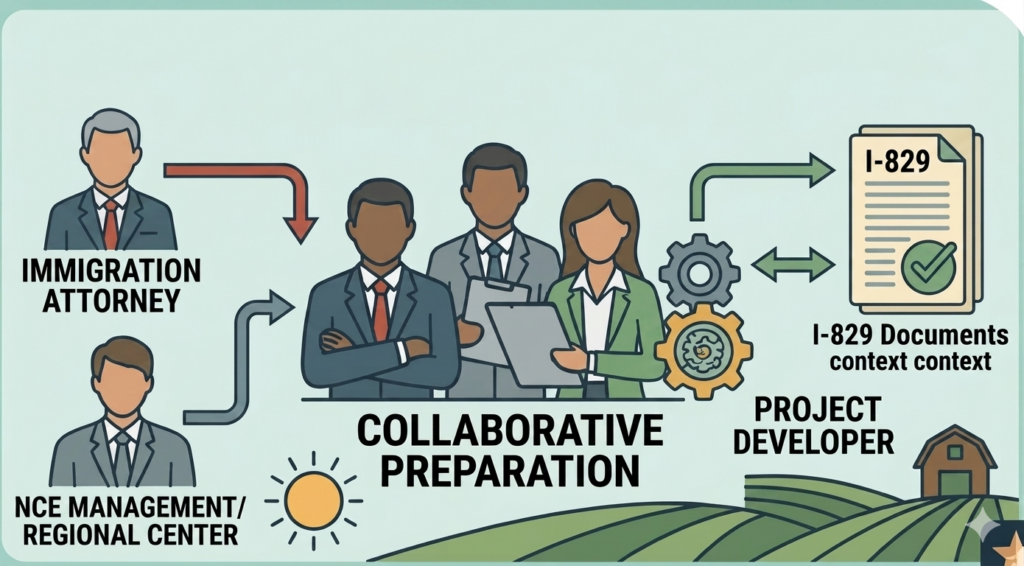
One of the most common questions investors ask during conditional residency is:
“Who prepares the I-829 documents — me, my attorney, the regional center, or the project?”
The answer is that I-829 preparation is usually a shared process. The investor is responsible for filing the petition, but many different parties provide the evidence needed to support it.
USCIS states that Form I-829 is used by the conditional permanent resident investor to request removal of conditions on permanent resident status. This means the petition belongs to the investor, even if much of the project evidence comes from others.
The Investor’s Responsibility
The investor is ultimately responsible for making sure the I-829 petition is filed on time.
This is very important. Even if the regional center, project sponsor, or attorney is helping, the investor should personally track the I-829 filing window.
The investor should keep:
- Conditional green card copies;
- I-526E approval notice;
- I-485 approval notice or immigrant visa admission records;
- Passport copies;
- Family documents;
- Address history;
- Tax documents from the NCE;
- Project communications;
- Evidence of the investment;
- Any notices from USCIS.
The investor should also update the attorney if there are major life changes, such as divorce, marriage of a child, a child aging out, long absences from the United States, or a family member obtaining conditional residence later than the principal investor.
The Immigration Attorney’s Role
The immigration attorney usually prepares and files the I-829 petition with USCIS.
The attorney’s role may include:
- Confirming the filing window;
- Reviewing the investor’s immigration history;
- Reviewing family member eligibility;
- Collecting personal documents;
- Organizing project evidence;
- Preparing legal arguments;
- Preparing the Form I-829 package;
- Responding to USCIS questions or RFEs;
- Tracking receipt notices and status extensions.
In my experience, a good I-829 attorney does not simply collect documents at the last minute. They should understand how the original I-526E was approved, what project structure was used, what changed during conditional residency, and whether the job creation and sustainment evidence is strong.
The Regional Center’s Role
For regional center EB-5 cases, the regional center often plays an important role in preparing project-level evidence.
This may include:
- Regional center sponsorship information;
- Project compliance updates;
- Job creation reports;
- Economic analysis;
- Evidence related to the project’s I-956F;
- Communications about project progress;
- Documentation showing EB-5 funds were used in the project.
The regional center may not file the investor’s I-829, but it often provides documents that are essential to the petition.
Investors should therefore remain in contact with the regional center during the conditional residence period.
The NCE’s Role
The New Commercial Enterprise, or NCE, is usually the entity in which the EB-5 investor owns an interest.
The NCE may provide:
- Proof of the investor’s continued ownership interest;
- Capital account statements;
- K-1s or tax documents;
- Bank records;
- Evidence of fund deployment;
- Communications to investors;
- Records showing how EB-5 funds were transferred to the JCE;
- Updates about repayment, redeployment, or restructuring.
In a loan model, the NCE may also provide evidence showing that it loaned EB-5 funds to the job-creating entity and that the funds remained deployed according to the project documents.
The Developer or JCE’s Role
The Job-Creating Entity, or JCE, is usually the project company that uses the EB-5 funds to build or operate the project.
The JCE or developer may provide:
- Construction spending records;
- Permits and approvals;
- Completion certificates;
- Payroll records;
- Operating records;
- Revenue reports;
- Job creation inputs;
- Evidence of project progress or completion.
For regional center projects, the developer may work with economists and project counsel to prepare the evidence needed for all investors’ I-829 petitions.
The Economist’s Role
In many regional center projects, an economist prepares or updates the job creation analysis.
This may be based on construction expenditures, operating revenue, tenant occupancy, direct payroll, or other project-specific inputs.
The economist’s report helps connect the project’s actual economic activity to the required job creation.
Investors do not usually prepare this report themselves, but they should understand whether the project has enough job cushion for all investors.
Why Investors Still Need to Stay Involved
Because many project documents come from the regional center and project team, some investors assume they do not need to do anything until the attorney contacts them.
That can be risky.
The investor should still:
- Track the I-829 window;
- Keep all green card records;
- Save project updates;
- Make sure the attorney has current contact information;
- Ask whether project evidence is ready;
- Confirm whether all family members are being included;
- Keep records of long international travel;
- Respond quickly to attorney requests.
I-829 preparation works best when the investor, attorney, regional center, NCE, and project team coordinate early.
Final Thoughts
The I-829 petition is the investor’s petition, but the supporting documents often come from several parties.
The investor is responsible for filing on time. The immigration attorney prepares and submits the case. The regional center, NCE, JCE, developer, economist, and project counsel usually provide the project-level evidence.
After helping many families through this stage, my advice is simple: do not assume someone else is tracking everything for you.
Even in a strong project, the investor should maintain a simple I-829 folder from the first day of conditional residence. Keep personal records, project updates, tax documents, and attorney communications organized. When the I-829 window arrives, this preparation can make the final EB-5 filing much smoother.
3. What Happens If You Miss the I-829 Filing Window?
Missing the I-829 filing window is one of the most serious mistakes an EB-5 investor can make.
After receiving conditional permanent residence, EB-5 investors must file Form I-829 to remove the conditions on their green card. USCIS states that this petition must generally be filed during the 90-day period immediately before the second anniversary of the investor obtaining conditional permanent resident status.
This window is not just a suggestion. It is a critical deadline.
Why the I-829 Filing Window Matters
The conditional green card is valid for two years. The purpose of the I-829 filing is to ask USCIS to remove the conditions before that two-year period ends.
If the investor files the I-829 properly and on time, the investor’s conditional permanent resident status is generally extended while USCIS reviews the petition. USCIS’s I-829 page explains that the form is used by conditional permanent residents who obtained status through a qualifying investment and want to remove the conditions.
The filing receipt becomes extremely important because it helps prove continued status after the conditional green card expires.
What If You File Late?
If an investor misses the filing window, the situation can become serious.
USCIS policy explains that if the investor does not file Form I-829 as required, USCIS may terminate conditional permanent resident status and issue a notice.
A late filing may be accepted only if the investor can show good cause and extenuating circumstances. This is not something investors should rely on casually.
Examples that may be reviewed could include serious illness, events outside the investor’s control, or other extraordinary circumstances. But each case depends on the facts and evidence.
Simply forgetting the deadline, misunderstanding the date, moving homes, or assuming the project would handle everything may not be enough.
What Should You Do If You Missed the Deadline?
If you missed the I-829 deadline, contact an experienced EB-5 immigration attorney immediately.
Do not wait. Do not travel internationally without legal advice. Do not assume that the issue can be fixed later.
The attorney may need to:
- Review the green card dates;
- Confirm the exact filing window;
- Determine how late the filing is;
- Review why the deadline was missed;
- Prepare a late I-829 filing if possible;
- Collect evidence of good cause and extenuating circumstances;
- Communicate with USCIS if needed;
- Advise on travel and work-status risks.
The longer the delay, the more complicated the case may become.
What About Family Members?
Missing the I-829 window may affect not only the principal investor but also derivative family members.
The spouse and children who obtained conditional residence through the investor may depend on the principal investor’s I-829 filing.
This is one reason families should track every family member’s green card dates carefully. Some family members may have different “Resident Since” dates if they entered the United States or received adjustment approval later.
Families should not assume that one date applies to everyone.
Why Investors Miss the Deadline
In my experience, missed I-829 deadlines usually happen for practical reasons, not because investors intentionally ignore the requirement.
Common reasons include:
- Believing the 2-year green card automatically renews;
- Thinking the attorney or regional center will track the deadline;
- Moving to a new address and missing notices;
- Family members having different approval dates;
- Confusing I-526E approval date with green card start date;
- Waiting too long to collect project documents;
- Not understanding that the I-829 window opens before the card expires.
These mistakes are preventable with a simple calendar system.
How to Avoid Missing the Window
When the conditional green card arrives, immediately check the Resident Since date and the expiration date.
Then ask your attorney to confirm the I-829 filing window in writing.
A good practice is to set reminders:
- 12 months before expiration;
- 6 months before expiration;
- 120 days before expiration;
- Opening day of the 90-day I-829 window;
- 30 days before the window closes.
Do not wait until the final month to begin document collection. Project-level documents, tax records, and family documents may take time to organize.
Final Thoughts
Missing the I-829 filing window can put the investor’s conditional permanent resident status at risk.
The best solution is prevention. Track the date early, keep your attorney informed, stay in contact with the regional center, and prepare the documents before the window opens.
After helping many EB-5 families, I usually tell investors: the I-829 deadline should be treated like one of the most important dates in your EB-5 journey.
Receiving the conditional green card is a major achievement, but protecting that status requires timely action. The I-829 filing window is the bridge between conditional residence and permanent residence without EB-5 conditions.