
After working with EB-5 investors and their families for more than 10 years, I have found that many investors feel relieved once they receive their conditional green card. That is understandable. It is a major milestone. But for EB-5 investors, the conditional green card is not the final step.
The final major immigration filing is usually Form I-829, where the investor shows USCIS that the EB-5 requirements were met after receiving conditional residence.
What Is the Purpose of I-829?
The purpose of Form I-829 is to prove that the investor complied with the EB-5 program requirements during the conditional residency period.
At the I-526E stage, USCIS reviews whether the investor appears eligible to become an EB-5 immigrant investor.
At the I-829 stage, USCIS reviews whether the investment was actually sustained and whether the job creation requirement was satisfied.
When Is Form I-829 Filed?
Form I-829 must generally be filed during the 90-day period immediately before the second anniversary of the investor becoming a conditional permanent resident. USCIS confirms that EB-5 investors file Form I-829 within the 90-day period before the second anniversary of obtaining conditional permanent resident status.
This filing window is very important. Investors should not wait until the green card is already expired to begin preparing the case.
What Documents Are Usually Included?
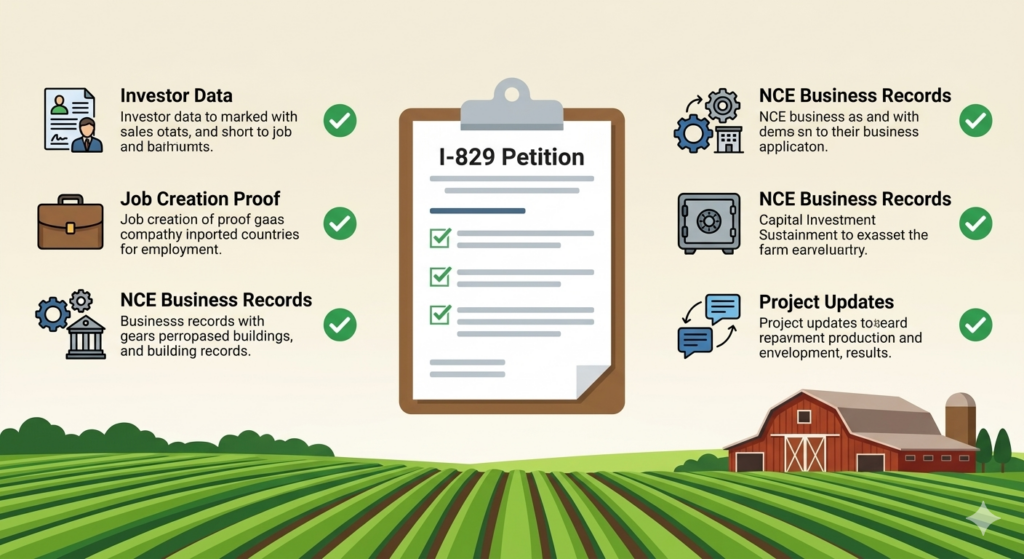
An I-829 petition usually includes both investor-level documents and project-level documents.
Investor-level documents may include:
- Copy of the conditional green card;
- I-526E approval notice;
- Conditional residence approval records;
- Passport and identity documents;
- Family member information;
- Evidence of continued investment;
- Tax documents received from the NCE;
- Proof of capital contribution;
- Updated address and personal information.
Project-level documents may include:
- Job creation report;
- Economic impact report updates;
- Construction spending evidence;
- Payroll records, if direct jobs are used;
- Business operation evidence;
- NCE and JCE records;
- Bank statements and deployment evidence;
- Project completion or progress reports;
- Regional center or fund manager certifications;
- Evidence showing the EB-5 capital was used according to the approved plan.
For regional center projects, much of the project-level evidence is usually prepared by the regional center, NCE, developer, economist, and project counsel.
Job Creation Evidence
One of the most important parts of I-829 is proving job creation. USCIS policy explains that the immigrant investor category requires investment of capital, engagement in a new commercial enterprise, and job creation.
For a direct EB-5 investment, job creation may be shown through actual full-time employees. This may include payroll records, tax filings, Forms I-9, W-2 records, and other employment evidence.
For a regional center investment, job creation may often be supported through an economic model using project spending, revenue, or other approved inputs. In this case, the investor may rely heavily on documents provided by the project team.
Investors should not assume job creation will be proven automatically. They should stay in contact with the project and ask for regular updates during conditional residence.
Sustainment of Investment
USCIS also reviews whether the investor sustained the EB-5 investment for the required period. USCIS policy states that, at the I-829 stage, it reviews whether the investor sustained the investment for the required period from the date conditional permanent residence was obtained.
This means the investor should keep evidence showing that the capital remained invested and at risk as required.
The investor does not usually need to personally manage the EB-5 project, especially in a regional center structure. But the investor should still keep records from the NCE and project team showing that the funds remained deployed in a qualifying manner.
Family Members in the I-829 Petition
The principal investor’s spouse and qualifying children are usually included in the I-829 petition if they obtained conditional permanent residence through the investor.
However, families should check timing carefully. Different family members may have different conditional green card approval dates, especially if they entered the United States at different times or had separate adjustment approvals.
Investors should provide copies of each family member’s green card and immigration records.
Final Thoughts
The I-829 petition is not just another form. It is the filing that asks USCIS to remove the EB-5 conditions and confirm the investor’s permanent resident status.
A strong I-829 petition should show that the investor made the required investment, sustained the investment, and that the project created or can support the required jobs under EB-5 rules.
After helping many families through the EB-5 process, my practical advice is simple: do not wait until the I-829 window opens to start paying attention.
Keep your green card records, project updates, tax documents, NCE communications, and job creation information organized throughout conditional residency. The better the records are maintained during the two-year period, the easier the I-829 preparation will be.