
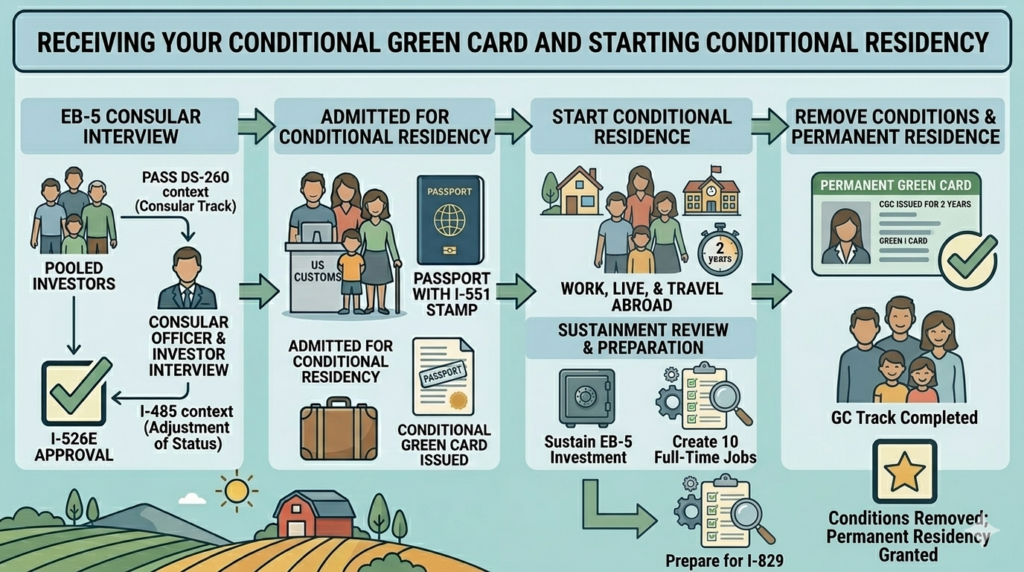
EB-5 investors normally receive conditional permanent residence for two years. Before that two-year period ends, they must file Form I-829 to ask USCIS to remove the conditions and grant permanent resident status without the EB-5 conditions. USCIS confirms that a conditional permanent resident receives a Green Card valid for two years.
When Does Conditional Residency Begin?
The starting date depends on how the investor received the green card.
Through Adjustment of Status
If the investor was already in the United States and USCIS approved Form I-485, conditional permanent residence generally begins on the date the adjustment application is approved.
The approval notice and green card should show the date on which permanent resident status began.
Through Consular Processing
If the investor completed the immigrant visa process through a U.S. embassy or consulate, the immigrant visa itself does not immediately make the investor a permanent resident.
The investor generally becomes a conditional permanent resident when admitted to the United States using the EB-5 immigrant visa.
The Department of State instructs immigrant visa holders to enter the United States before the expiration date printed on the visa.
This distinction matters because the two-year conditional period and the future I-829 filing window are calculated from the date conditional permanent residence begins—not from the date the I-526E was filed or approved.
What Is a Conditional Green Card?
A conditional green card provides lawful permanent resident status, but it is valid for only two years.
During this period, an EB-5 investor is generally a permanent resident for most everyday purposes. The investor may live in the United States, work for an employer, operate a business, attend school, and travel internationally, subject to the same general residence and travel rules that apply to other permanent residents.
The word “conditional” does not mean the investor has only a temporary visitor visa. It means the permanent residence is subject to a later review of the EB-5 requirements.
At the I-829 stage, USCIS reviews whether the investment and job-creation requirements were satisfied under the applicable EB-5 rules.
When Will the Physical Green Card Arrive?
For investors who adjust status in the United States, USCIS generally mails the physical green card after approving Form I-485.
For investors who complete consular processing, the investor must normally pay the USCIS Immigrant Fee. The Department of State explains that USCIS will not issue the physical Permanent Resident Card until this fee has been paid.
The card is mailed to the U.S. address provided during the immigration process.
Investors should make sure that USCIS has a reliable and updated U.S. mailing address. If the family changes address after becoming permanent residents, they should follow USCIS address-change requirements rather than assuming mail will automatically be forwarded.
A delay in receiving the physical card does not necessarily mean the person has not become a permanent resident. The approval notice, immigrant visa endorsement, or other temporary evidence may help prove status while the card is being produced, depending on the case.
Do All Family Members Receive Conditional Green Cards?
The principal investor’s eligible spouse and unmarried children under 21 may generally obtain conditional permanent residence as derivative beneficiaries.
Each family member receives an individual green card and has their own permanent resident status.
Family members may not all become residents on exactly the same date. For example, the principal investor may enter the United States first, while the spouse or child enters later. In an adjustment case, family applications may also be approved on different dates.
This can create different green card expiration dates and potentially different I-829-related timing issues. Families should keep a copy of every approval notice, immigrant visa, admission record, and green card.
Do not assume that one family member’s dates automatically apply to everyone.
What Should You Check When the Green Card Arrives?
When the physical card arrives, review it immediately.
Check:
- The full legal name;
- Date of birth;
- Country of birth;
- Alien Registration Number;
- Resident Since date;
- Card expiration date; and
- Immigration category.
If any information is incorrect, contact the immigration attorney promptly and follow the USCIS process for correcting the card.
The Resident Since date is especially important because it helps determine when the two-year conditional period began and when the I-829 filing window will open.
Families should keep clear digital and paper copies of both sides of every green card.
What Rights Do Conditional Permanent Residents Have?
Conditional permanent residents generally have the right to live and work permanently in the United States, subject to the condition-removal requirement.
They are normally free to:
- Work for most U.S. employers;
- Change jobs;
- Start or operate a business;
- Attend school;
- Live in any U.S. state;
- Apply for a Social Security number if needed; and
- Travel outside the United States and seek reentry as permanent residents.
Regional center investors are not normally required to work for or manage the EB-5 project. Receiving permanent residence also does not require the investor to live in the same state where the EB-5 project is located.
For example, an investor may invest in a rural project in one state but live with the family in California, New York, Texas, or another location.
What Responsibilities Come With Permanent Residence?
A green card also creates responsibilities.
Permanent residents should comply with U.S. laws, file required tax returns, maintain accurate immigration records, and take steps to preserve the United States as their permanent home.
Male permanent residents within the relevant age range may also need to review Selective Service registration requirements.
Investors should obtain tax advice before or soon after becoming U.S. permanent residents. U.S. tax rules may apply to worldwide income and foreign financial assets, and the tax-residency consequences may begin when permanent resident status begins.
Immigration attorneys can explain immigration status, but a qualified cross-border tax professional should address individual tax planning.
Can You Travel Outside the United States?
Yes. Conditional permanent residents may travel internationally.
However, a green card should not be treated as permission to live indefinitely outside the United States.
Long or frequent absences may create questions about whether the person has abandoned permanent residence. USCIS warns that international travel may have serious immigration consequences depending on the circumstances.
Investors should not assume that entering the United States for one week every six months is automatically enough to keep a green card. U.S. permanent residence is based on maintaining the United States as your permanent home, not only on avoiding a single trip of more than six months. Long or frequent absences may still create questions about abandonment of residence or affect future naturalization planning. If extended travel is expected, investors should seek immigration advice before leaving the United States.
Do You Still Need to Monitor the EB-5 Project?
Yes. The investor should continue receiving and keeping:
- Construction or operating updates;
- Job-creation reports;
- Annual NCE reports;
- Schedule K-1 or other tax documents;
- Notices about material project changes;
- Evidence concerning deployment of EB-5 capital; and
- Communications about repayment or restructuring.
These records may become relevant when preparing Form I-829. Investors should keep their contact information current with the NCE, regional center, immigration attorney, and USCIS. Missing important project notices can create unnecessary problems later.
When Must Form I-829 Be Filed?
Form I-829 is used by EB-5 investors to request removal of the conditions on permanent residence.
USCIS requires the petition to be filed during the 90-day period immediately before the second anniversary of the investor obtaining conditional permanent residence.
For example, if the Resident Since date is October 15, 2026, the investor should not simply wait until October 15, 2028. The filing window begins approximately 90 days before that second anniversary.
This deadline should be calendared as soon as the conditional green card is received.
Do not rely only on the expiration date printed on the card. Ask the immigration attorney to confirm the precise filing window for the investor and each derivative family member.
What Happens After I-829 Is Filed?
When Form I-829 is properly filed, the investor’s conditional permanent resident status may be extended while USCIS reviews the petition.
Because USCIS processing may continue beyond the expiration date printed on the green card, investors should retain the I-829 receipt notice together with the expired card as evidence of continued status, subject to the instructions on the notice.
USCIS reviews whether the investor complied with the EB-5 requirements, including the required sustainment and job-creation elements. USCIS policy states that it reviews evidence concerning sustainment of the investment for the required period from the date conditional permanent residence was obtained.
The project team normally supplies much of the project-level evidence, while the investor and immigration attorney prepare the individual petition.
Common Mistakes During Conditional Residency
One common mistake is treating the green card as the final EB-5 approval and losing contact with the regional center or project.
Another is forgetting the I-829 filing window.
Other problems may include:
- Spending long periods outside the United States without advice;
- Failing to report a change of address;
- Losing approval notices and project records;
- Ignoring U.S. tax obligations;
- Assuming all family members have the same residency date;
- Failing to check errors on the green card; and
- Waiting until the final weeks to begin I-829 preparation.
These issues are much easier to manage when the family creates a simple compliance calendar at the beginning of conditional residence.
A Practical Conditional Residency Checklist
After receiving the conditional green card, I usually suggest that families:
- Confirm the Resident Since and expiration dates;
- Save copies of all cards and approval records;
- Calendar the I-829 filing window;
- Update the U.S. mailing address when necessary;
- Speak with a U.S. tax adviser;
- Plan international travel carefully;
- Keep project and NCE communications;
- Maintain contact with the immigration attorney; and
- Begin reviewing I-829 requirements well before the filing window.