
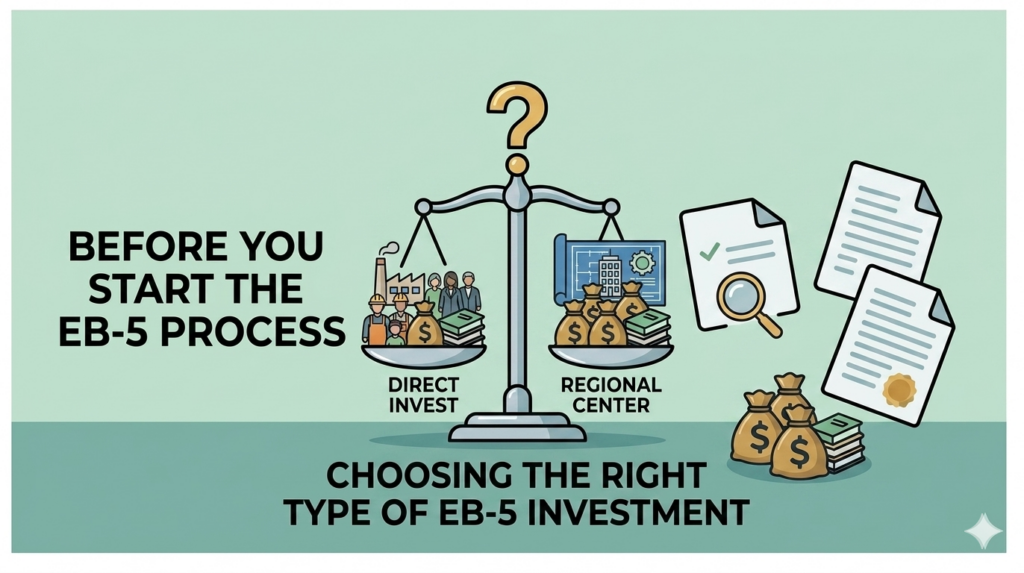
Over the past 10 years, I have met many investors who were ready to start EB-5, but they were not yet clear about one basic question: What type of EB-5 investment should I choose? This is an important question because EB-5 is not one single product. Different EB-5 investments may have different structures, timelines, job creation methods, risk levels, and levels of investor involvement. Before choosing a specific project, investors should first understand the main categories of EB-5 investment.
At a basic level, EB-5 investors usually compare two major choices: direct EB-5 investment and regional center EB-5 investment. Investors also need to consider whether the project qualifies for the lower investment amount, such as a rural area, high-unemployment area, or infrastructure project. Under current USCIS guidance, the standard EB-5 investment amount is generally $1,050,000, while the reduced investment amount is generally $800,000 for qualifying targeted employment area or infrastructure investments.
Direct EB-5 vs Regional Center EB-5
A direct EB-5 investment usually means the investor invests into and often operates or closely manages a business that directly creates jobs. In this model, the investor is usually more involved in business operations. Job creation is typically based on direct full-time employees of the business.
A regional center EB-5 investment is different. In this model, the investor usually invests through a USCIS-designated regional center project. The project may pool capital from many EB-5 investors and use that capital for a larger development, such as real estate, infrastructure, hospitality, senior living, manufacturing, or other job-creating projects. USCIS allows regional center investors to count indirect jobs, and up to 90% of the job creation requirement may be met using indirect jobs.
In my experience, most investors who want a more passive role tend to prefer regional center EB-5. They usually do not want to run a U.S. business by themselves. They want a project team, regional center, developer, economist, and immigration attorney to help support the project documentation.
Direct EB-5 may be more suitable for investors who already have a strong U.S. business plan and want operational control. But it is usually more demanding, because the investor must think not only like an immigration applicant, but also like a business operator.
Choosing by Location: Rural, High-Unemployment, or Standard
Location also matters. Many investors focus on rural EB-5 projects because rural projects may qualify for both the lower investment amount and reserved visa benefits. USCIS confirms that EB-5 visas are set aside each fiscal year for rural area investments, high-unemployment area investments, and infrastructure projects, with 20% reserved for rural, 10% for high-unemployment, and 2% for infrastructure.
This is why many investors from high-demand countries pay close attention to rural and high-unemployment projects. However, I usually remind investors that a lower investment amount or a faster category does not automatically mean a safer project.
The project still needs to be reviewed carefully. You should understand the developer’s track record, capital structure, construction status, job creation cushion, repayment source, and exit strategy.
Choosing by Your Own Goal
The best type of EB-5 investment depends on your personal goal.
If your goal is to operate your own U.S. business, direct EB-5 may be worth reviewing. If your goal is a more passive immigration investment, regional center EB-5 may be more practical. If your family has timing concerns, especially children close to 21, rural or set-aside categories may become important. If your main concern is repayment, you may focus more on capital structure and exit strategy than on location alone.
Before choosing a project, I suggest investors ask themselves:
Do I want to manage a business or be a passive investor?
Is my priority immigration timing, capital protection, or both?
Does my family need visa availability quickly?
Can I accept construction or market risk?
Do I understand how jobs will be created?
Final Thoughts
Choosing the right type of EB-5 investment is not about following what other investors are doing. It is about matching the investment type to your immigration goal, financial situation, family timeline, and risk tolerance.
After working with many EB-5 families, I believe the strongest decisions are made when investors slow down at the beginning. Before asking, “Which project should I choose?” first ask, “Which type of EB-5 investment actually fits my family?”