
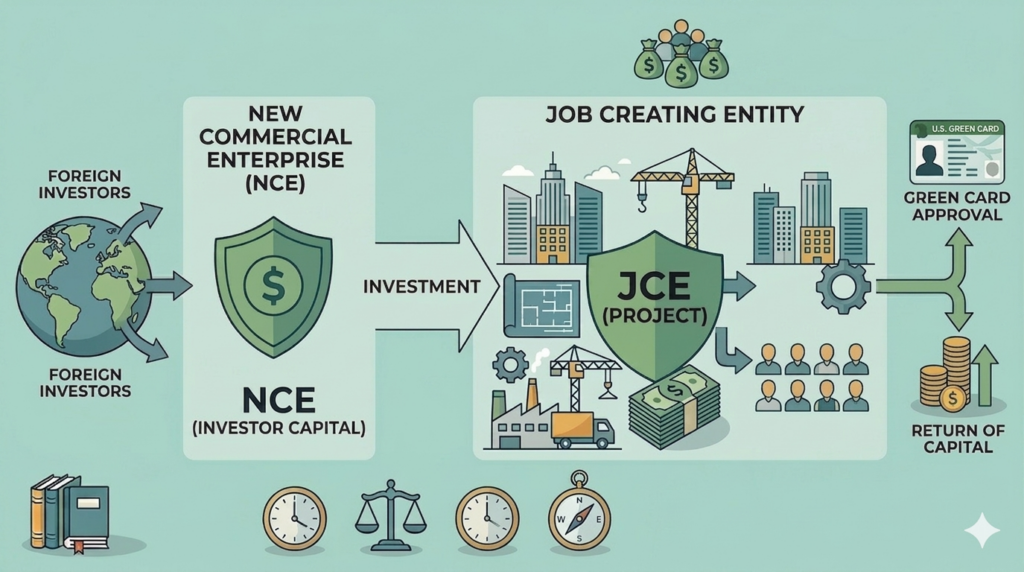
When I explain EB-5 project structure to investors, I usually start with two terms: NCE and JCE. These two entities appear in almost every regional center project, and if an investor does not understand the difference between them, it becomes very difficult to understand the project documents, the fund flow, the job creation plan, and the repayment structure.
USCIS describes EB-5 eligibility around three basic elements: the investor must invest capital, engage in a new commercial enterprise, and the investment must create jobs. In a regional center project, the NCE, or New Commercial Enterprise, is usually the entity that EB-5 investors invest into. The JCE, or Job-Creating Entity, is usually the entity that receives or uses the EB-5 capital to develop, build, operate, or expand the project.
The easiest way to understand it is this:
NCE vs JCE: Simple Comparison
| Item | NCE | JCE |
|---|---|---|
| Full Name | New Commercial Enterprise | Job-Creating Entity |
| Simple Meaning | The investment entity investors join | The project entity that uses the funds |
| Main Role | Receives EB-5 investors’ capital | Develops, builds, operates, or expands the project |
| Investor Relationship | Investors usually have a direct legal relationship with the NCE | Investors usually do not invest directly into the JCE |
| Common Structure | Limited partnership or LLC | Project company, development company, or operating business |
| Key Documents | Subscription Agreement, PPM, Operating Agreement, Limited Partnership Agreement | Loan Agreement, project documents, business plan, construction or operating documents |
| Main Question for Investors | What rights do I have as an investor? | Can this entity complete the project and create jobs? |
| Risk Focus | Investor rights, fees, distributions, withdrawal limits, redeployment | Construction risk, operating risk, job creation risk, repayment risk |
How EB-5 Money Usually Flows
| Step | What Happens | Why It Matters |
|---|---|---|
| 1. Investor subscribes to the NCE | The investor signs the subscription documents and joins the NCE as a limited partner or LLC member. | This is where the investor legally enters the EB-5 investment. |
| 2. Investor funds are sent to escrow or the NCE | The investor transfers the EB-5 capital according to the project documents. | Investors need to know where the money is held and when it can be released. |
| 3. NCE deploys capital to the JCE | The NCE usually lends or invests the pooled EB-5 funds into the JCE. | This is the connection between the investor fund and the real project. |
| 4. JCE uses the funds | The JCE uses the money for construction, development, business expansion, equipment, or operations. | This is where job creation usually happens. |
| 5. Project creates jobs | Jobs may be created directly, indirectly, or through economic modeling in a regional center project. | Job creation is critical for the investor’s EB-5 immigration result. |
| 6. JCE repays the NCE | If the project succeeds, the JCE may repay the NCE through refinance, sale, or cash flow. | This affects when and how investors may receive their capital back. |
| 7. NCE returns capital or redeploys funds | Depending on immigration timing and project documents, the NCE may return or redeploy the capital. | Investors must understand lock-up period and redeployment risk. |
Three Relationships Investors Must Understand
| Relationship | What Investors Should Understand | Key Questions to Ask |
|---|---|---|
| Investor → NCE | This is your direct investment relationship. Your rights are usually defined at the NCE level. | Am I a limited partner or LLC member? Who manages the NCE? What voting rights do I have? Can I withdraw? |
| NCE → JCE | This explains how your money moves from the investment fund to the project company. | Is the NCE making a loan or equity investment? Is there collateral? What is the repayment term? Can the loan be extended? |
| JCE → Actual Project | This shows whether the project company can actually execute the project and create jobs. | Does the JCE own or control the project? Does it have permits? Is financing secured? Can it complete construction? |
n my view, an investor should never choose a project before understanding the NCE/JCE structure. It answers several practical questions: Where does my money go? Who controls it? Who uses it? Who creates the jobs? Who owes repayment? Who supports my I-829 petition?
The NCE and JCE are not just legal terms. They are the foundation of the EB-5 project structure. Once you understand them, the rest of the project documents become much easier to read.