
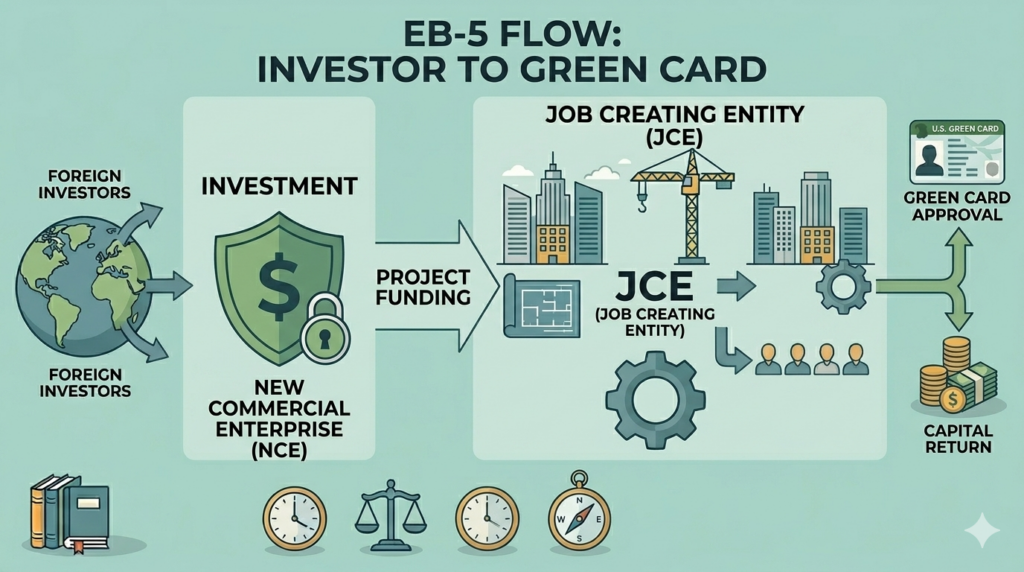
When EB-5 investors first review a project, they often focus on the name of the regional center, the developer, or the project location. But one of the most important entities to understand is the JCE, which stands for Job-Creating Entity.
In simple terms, the JCE is the company that actually uses the EB-5 capital to develop, build, operate, or expand the project. If the NCE is the entity that receives investors’ capital, the JCE is usually the entity that puts that capital to work.
In many regional center EB-5 projects, investors do not invest directly into the JCE. Instead, they invest into the NCE, or New Commercial Enterprise. The NCE then provides funds to the JCE, often through a loan, preferred equity investment, or another financing structure. The JCE uses those funds for eligible project expenses, such as construction, development, equipment, operations, or business expansion.
The reason the JCE is so important is because EB-5 is not only about investing money. It is also about creating jobs. USCIS requires EB-5 investment to be connected to job creation. In general, each EB-5 investor must be credited with at least 10 qualifying jobs. In a regional center project, those jobs may include direct, indirect, and induced jobs, depending on the project structure and economic methodology.
This is why I often tell investors: the NCE may be where your money legally enters the investment, but the JCE is where the immigration result is often created.
For example, if the EB-5 project is a hotel development, the JCE may be the company that owns or develops the hotel. If the project is a residential development, the JCE may be the project company responsible for construction. If the project is an operating business, the JCE may be the business that hires employees and generates revenue.
When reviewing a JCE, investors should ask practical questions:
Who owns the JCE?
Who manages it?
Does it have experience completing similar projects?
Does it already control the project site?
Has financing been secured?
What is the relationship between the JCE and the developer?
How exactly will jobs be created?
What happens if the JCE faces delays, cost overruns, or financial problems?
These questions matter because the JCE carries much of the project execution risk. If the JCE cannot complete the project, cannot spend the funds as planned, or cannot support the job creation forecast, investors may face immigration risk and repayment risk.
It is also important to understand the agreement between the NCE and the JCE. If the NCE lends money to the JCE, investors should review the loan agreement, repayment terms, interest rate, collateral, maturity date, and extension rights. If the NCE makes an equity investment into the JCE, investors should understand where that equity sits in the capital structure and how repayment may occur.
A strong JCE does not guarantee success, but it gives investors more confidence that the project can be completed and jobs can be created. A weak or unclear JCE structure can be a warning sign, even if the marketing materials look attractive.
In my view, every EB-5 investor should understand the JCE before choosing a project. You are not only reviewing a green card pathway. You are reviewing a real business that must use your capital, execute a project, and support your immigration process.
The better you understand the JCE, the better you can understand the real engine behind the EB-5 project.