
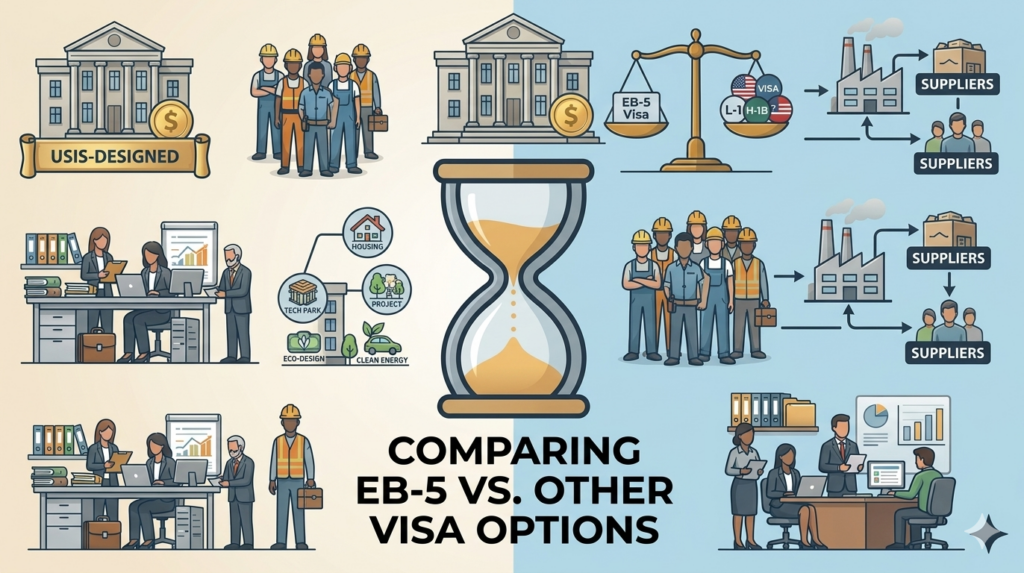
EB-5 investors usually choose between two main paths: regional center EB-5 and direct EB-5. Both can lead to a green card, but they are designed for different investor profiles.
A regional center EB-5 investment is usually more passive. The investor typically invests into a project sponsored by a USCIS-designated regional center. Many regional center projects are real estate, infrastructure, senior living, hotel, mixed-use, or other development-related projects. One major advantage is that regional center projects may use economic models to count indirect and induced jobs, not only direct employees.
This structure can be attractive for investors who want immigration benefits but do not want to personally manage a U.S. business. However, investors still need to conduct due diligence. The regional center model does not remove investment risk, project risk, or immigration risk.
A direct EB-5 investment usually involves investing directly into a business that creates the required jobs. In many cases, the jobs must be direct, full-time positions on the company’s payroll. Direct EB-5 may fit investors who want to own or operate a U.S. business, such as a restaurant group, franchise, manufacturing business, logistics company, or service business.
The direct route may offer more control, but it can also require more management responsibility while till being subject to the same reporting requirements as a regional center project. The investor must pay attention to hiring, payroll, business operations, compliance, and job creation evidence. For example, you can operate a successful business, but if USCIS deems that your hiring was insufficent or not maintained to their required levels, then they can still deny your I-829 and withdraw all of your green card statuses, whether conditional or permanent.
The best choice depends on the investor’s goals. If the investor wants a more passive immigration-focused structure, regional center EB-5 may be more suitable. If the investor wants business control and is comfortable operating in the U.S., direct EB-5 may be worth considering.
There is no universal “better” option. The real question is: which structure better matches your immigration timeline, risk tolerance, business experience, and family plan?