When EB-5 investors review a project, they often ask me very direct questions:
Is this project safe?
How will I get my money back?
Who gets repaid first if something goes wrong?
Why does one project pay a higher return than another?
To answer these questions, investors need to understand the capital stack. It tells you who provides the money, who gets paid first, who takes more risk, and who may receive more return.
What Is a Capital Stack?
A real estate or business project usually does not use only one source of money. It may combine bank loans, EB-5 funds, private loans, preferred equity, and developer equity.
These layers together form the capital stack.
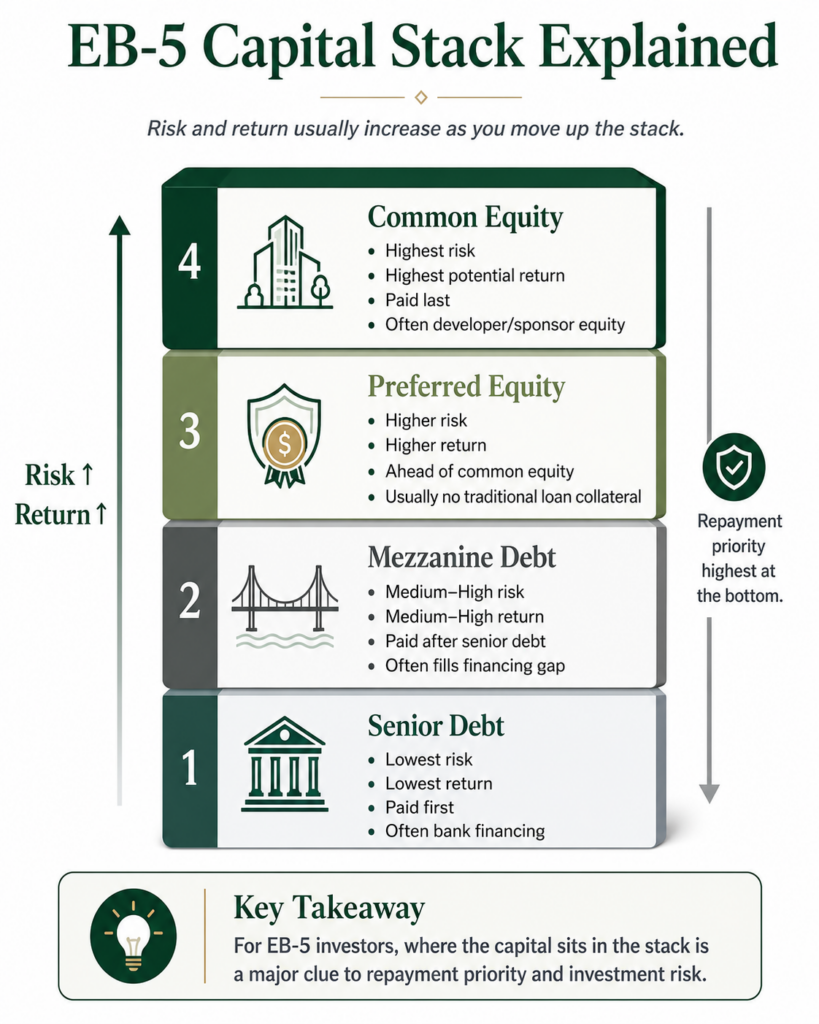
A simple capital stack may look like this:
| Capital Layer | General Position | Risk Level | Return Level |
|---|---|---|---|
| Senior Debt | Highest repayment priority | Lowest risk | Lowest return |
| Mezzanine Debt | Behind senior debt, ahead of equity | Medium to high risk | Medium to high return |
| Preferred Equity | Ahead of common equity, behind debt | Higher risk | Higher return |
| Common Equity | Last to be repaid | Highest risk | Highest potential return |
The higher you move in the capital stack, the more risk the capital usually takes. The lower you sit in the capital stack, the more protection and repayment priority you usually have.
However, this is only a general rule. The exact risk depends on the legal documents, collateral, project quality, market conditions, and whether the project can actually complete and repay.
Why Capital Stack Matters in EB-5
USCIS requires the investment to be “at risk,” meaning the investor’s capital must be subject to real business risk. EB-5 is not supposed to be a guaranteed deposit or risk-free product. (uscis.gov) This means EB-5 investors must accept some level of investment risk. But not all risks are equal.
A project where EB-5 capital is secured by strong collateral and sits near the lower-risk part of the capital stack may be very different from a project where EB-5 capital sits behind large senior debt and depends entirely on future project success.
Industry EB-5 materials often explain that capital stack layers—such as senior debt, mezzanine debt, preferred equity, and common equity—carry different levels of repayment priority, risk, and expected return. (eb5investors.com). So when an investor asks, “Is this EB-5 project safe?” I usually respond with another question:
Where does EB-5 capital sit in the capital stack?
1. Senior Debt: Lower Risk, Lower Return
Senior debt usually sits at the bottom of the capital stack from a risk perspective, meaning it has the highest repayment priority.
Senior debt is often provided by a bank, construction lender, or institutional lender. In many real estate projects, the senior lender has a first lien on the property or major project assets.
This means if the project performs well, the senior lender is repaid first. If the project fails, the senior lender usually has the first claim on collateral.
| Senior Debt Feature | What It Means |
| Repayment priority | Usually paid first |
| Security | Often secured by first lien on project assets |
| Risk level | Generally lowest in the capital stack |
| Return level | Usually lowest |
| Typical lender | Bank, construction lender, institutional lender |
Because senior debt has stronger protection, it usually receives a lower return. The lender accepts lower return because it has better repayment priority and collateral rights.
For EB-5 investors, if EB-5 capital is structured as senior debt, this may be more conservative than many other structures. But investors still need to ask:
- Is EB-5 truly senior debt?
- Does it have first-priority collateral?
- Is there another lender ahead of the NCE?
- What is the loan-to-value ratio?
- Can the borrower extend the loan?
- What happens if the project defaults?
The word “senior” is helpful, but investors still need to read the loan and security documents.
2. Mezzanine Debt: Higher Risk, Higher Return
Mezzanine debt sits between senior debt and equity.
It is usually riskier than senior debt because it is paid after the senior lender. It may be secured by a pledge of ownership interests rather than a direct first lien on the property. In some cases, it may have limited collateral protection.
EB-5 industry materials often note that EB-5 capital may be structured as mezzanine financing, sitting below senior loans but above developer equity. (canamenterprises.com)
| Mezzanine Debt Feature | What It Means |
| Repayment priority | Behind senior debt, ahead of equity |
| Security | May be secured by equity pledge or other secondary collateral |
| Risk level | Medium to high |
| Return level | Higher than senior debt |
| Typical use | Fills financing gap between bank loan and equity |
Because mezzanine debt takes more risk, it usually expects a higher return than senior debt. In general finance, mezzanine financing is often described as a hybrid between debt and equity and may carry higher returns because it is subordinated to senior debt. (investopedia.com)
For EB-5 investors, mezzanine debt can be common. It does not automatically mean the project is bad. But investors should understand that if the project is sold, refinanced, or liquidated, the senior lender is usually paid before the mezzanine lender.
Key questions include:
- How large is the senior loan?
- What collateral supports the mezzanine loan?
- Is there an intercreditor agreement?
- Can the mezzanine lender enforce rights if the senior lender objects?
- Is the repayment source realistic?
- What happens if refinancing is delayed?
A mezzanine position may provide stronger rights than equity, but it is usually not as protected as senior debt.
3. Preferred Equity: Priority Over Common Equity, But Still Equity Risk
Preferred equity sits below debt but above common equity.
Preferred equity investors usually receive a preferred return before common equity investors receive profit distributions. However, preferred equity is still generally riskier than debt because it may not have the same legal repayment obligation as a loan.
| Preferred Equity Feature | What It Means |
| Repayment priority | Behind debt, ahead of common equity |
| Security | Usually no traditional loan collateral |
| Risk level | Higher than debt |
| Return level | Higher than debt in many cases |
| Investor position | Equity investor with preferential rights |
Preferred equity may be attractive to a project because it does not always require fixed loan payments. It can give the project more flexibility than debt. But from the investor’s perspective, this may also mean less certainty around repayment timing.
Preferred equity may include:
- Preferred return;
- Priority distributions;
- Redemption rights;
- Certain approval rights;
- Conversion rights;
- Special protections if the project performs poorly.
For EB-5 investors, preferred equity requires careful review. You need to know:
- What return is preferred?
- Is the preferred return cumulative?
- When can the investment be redeemed?
- Who controls the redemption decision?
- What happens if the project has no cash flow?
- Does preferred equity sit behind all project debt?
- Are there any collateral-like protections?
4. Common Equity: Highest Risk, Highest Potential Return
Common equity is usually the riskiest layer of the capital stack.
Common equity often comes from the developer, sponsor, or project owner. It sits behind senior debt, mezzanine debt, and preferred equity. If the project is successful, common equity may receive the greatest upside. If the project fails, common equity may be the first layer to lose value.
| Common Equity Feature | What It Means |
| Repayment priority | Last |
| Security | Usually ownership upside, not collateral |
| Risk level | Highest |
| Return level | Highest potential return |
| Typical provider | Developer, sponsor, project owner |
For investors, common equity is important because it shows how much the developer is personally committed to the project.
If the developer contributes meaningful common equity, it may suggest the developer has “skin in the game.” If the developer contributes very little equity and relies heavily on loans or EB-5 funds, investors should ask more questions.
I often tell investors:
Developer equity is not only a funding source. It is also a sign of alignment.
If the developer’s money is at risk before profits are earned, the developer may have stronger motivation to complete the project successfully.
Where Does EB-5 Capital Usually Sit?
EB-5 capital can sit in different positions depending on the project structure.
It may be:
- Senior debt;
- Second-position debt;
- Mezzanine debt;
- Preferred equity;
- Common equity;
- Another structured investment.
Many regional center EB-5 offerings use a loan model, but not all EB-5 loans have the same priority. Some may be senior secured loans. Others may sit behind a bank construction loan. Some may be unsecured or supported mainly by a pledge of equity interests.
Risk and Return: The Basic Rule
In finance, there is a general relationship between risk and return.
Lower-risk capital usually receives lower return. Higher-risk capital usually expects higher return.
| Capital Type | Risk Level | Expected Return Level | Why |
| Senior Debt | Lower | Lower | Stronger repayment priority and collateral |
| Mezzanine Debt | Medium to High | Medium to High | Paid after senior debt |
| Preferred Equity | High | High | Equity risk but priority over common equity |
| Common Equity | Highest | Highest potential upside | Last to be repaid but benefits most if project succeeds |
This is why EB-5 investor returns are often low. Many EB-5 investors are not investing primarily for high yield. Their main goals are immigration eligibility, job creation, capital preservation, and eventual repayment.
A project promising unusually high returns may not automatically be better. It may simply be asking investors to accept higher risk.
How Investors Should Review the Capital Stack
Before selecting a project, I would ask:
- What is the total project cost?
- How much senior debt is in the project?
- How much developer equity is invested?
- How much EB-5 capital is being raised?
- Is EB-5 debt or equity?
- Is EB-5 senior, mezzanine, preferred equity, or common equity?
- Is there collateral?
- Who gets repaid before the NCE?
- What happens if the project is delayed?
- What is the realistic repayment source?
- Can the EB-5 loan be extended?
- Does the developer have enough equity at risk?
- Is the capital stack already funded or still dependent on future fundraising?
These questions help investors move beyond marketing language and understand the real financial structure.
My View
Senior debt usually has lower risk and lower return.
Mezzanine debt takes more risk and expects more return.
Preferred equity has priority over common equity but still carries equity risk.
Common equity has the highest risk but the highest potential upside.
For EB-5 investors, the goal is usually not to chase the highest return. The goal is to choose a project where the capital structure, job creation, repayment plan, and investor protections make sense together.
To easy remember each structure, save below photo.