
Many investors think that once the I-526E is approved and the conditional green card is issued, the difficult part of EB-5 is over.
In many ways, that is true. But the final EB-5 review happens at the I-829 stage.
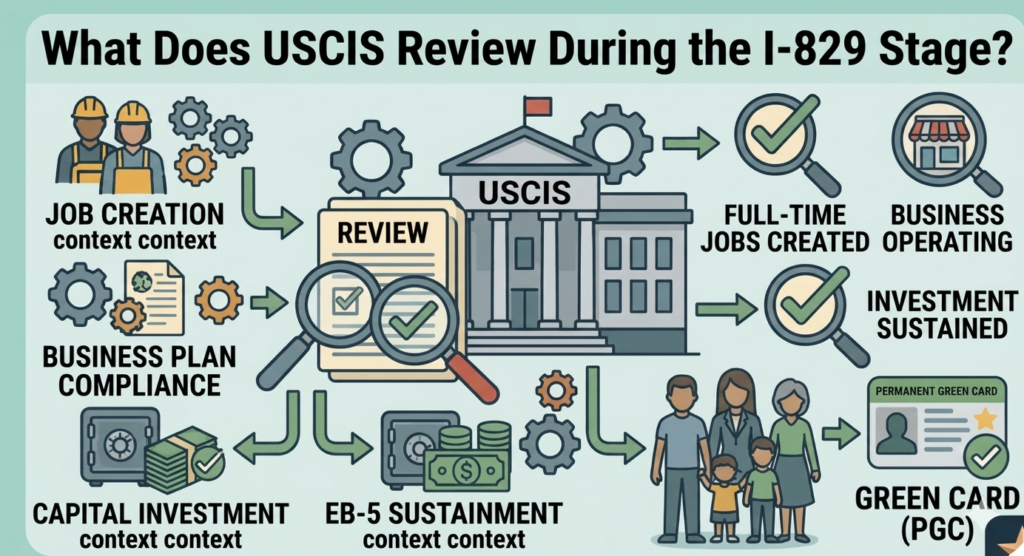
Form I-829 is the petition used by EB-5 investors to ask USCIS to remove the conditions on permanent resident status. USCIS’s policy manual explains that the investor must file Form I-829 to seek removal of conditions, and USCIS reviews whether the investor satisfied the EB-5 requirements.
In simple terms, USCIS wants to confirm that the investor followed through on the EB-5 plan.
1. Did the Investor Invest the Required Capital?
USCIS may review whether the investor made the required qualifying investment into the new commercial enterprise.
At the I-526E stage, the investor already submitted evidence of the investment or active investment process. At the I-829 stage, USCIS may review whether the capital was actually contributed and remained connected to the EB-5 project.
This may include evidence of:
- Initial capital transfer;
- Subscription acceptance;
- NCE ownership;
- Capital account records;
- Bank transfer confirmations;
- Escrow release records;
- Fund deployment to the JCE.
For most investors, the I-829 stage is not about re-proving the entire source of funds unless USCIS identifies a problem. But the petition still needs to show that the qualifying capital was invested.
2. Was the Investment Sustained?
Sustainment is one of the key I-829 issues.
USCIS policy states that it reviews evidence showing the investor sustained the investment for the required period, beginning from the date the investor obtained conditional permanent residence.
The exact sustainment analysis may depend on whether the investor filed before or after the EB-5 Reform and Integrity Act and how the project was structured.
For investors, the practical point is this: USCIS wants to see that the investment was not withdrawn too early and that the capital remained at risk as required.
If the project repaid funds, redeployed capital, restructured, or changed materially during the conditional period, the I-829 petition may need to explain what happened and provide supporting evidence.
3. Were the Required Jobs Created?
Job creation is usually the most important project-level issue.
The EB-5 program generally requires each investor’s capital to create at least 10 qualifying full-time jobs for U.S. workers. USCIS policy identifies job creation as one of the three core EB-5 requirements.
For direct EB-5 cases, USCIS may review actual payroll and employment records.
For regional center projects, job creation may be supported by an economic analysis. The report may rely on construction spending, operating revenue, direct payroll, tenant occupancy, or other approved inputs.
Investors should review whether the project has enough job cushion. If a project barely creates enough jobs, any reduction in spending, delay, or change in assumptions may create risk.
4. Did the Investor Maintain Conditional Permanent Residence?
USCIS may also review whether the investor and family members properly held conditional permanent resident status.
This may include reviewing:
- Green card copies;
- Admission records;
- I-485 approvals or immigrant visa entries;
- Family member status;
- Divorce, marriage, or death issues;
- Separate filings for certain derivatives if needed.
Long absences from the United States may also create separate residence or abandonment concerns. These issues should be reviewed with an attorney, especially before international travel.
5. Were There Material Changes?
USCIS may consider whether the project or investment changed in a way that affects EB-5 eligibility.
Not every change is a problem. Construction delays, budget changes, operational adjustments, or redeployment events may happen in real projects.
But the I-829 petition should explain important changes clearly and show that the investor still meets EB-5 requirements.
For example:
- Did the NCE remain in existence?
- Was the capital still deployed?
- Were the jobs still created?
- Did the project remain within EB-5 requirements?
- Did any repayment or redeployment affect sustainment?
A good I-829 package should not ignore major project developments.
6. Is the Evidence Consistent?
USCIS may compare the I-829 filing with earlier filings, including I-526E and project documents.
Inconsistencies may create questions. For example:
- Different investment amounts;
- Different project timelines;
- Unexplained fund movement;
- Conflicting job creation numbers;
- Different ownership records;
- Missing NCE or JCE documentation.
This is why investors should keep the original I-526E approval package, project updates, and I-829 evidence organized.
Final Thoughts
At the I-829 stage, USCIS is not simply checking whether the investor still has a green card. It is reviewing whether the EB-5 investment met the conditions required for permanent residence.
The main questions are:
- Was the required capital invested?
- Was the investment sustained?
- Were the required jobs created?
- Did the investor maintain eligibility?
- Are the project and investor records consistent?
After helping many families through the EB-5 process, I usually explain I-829 as the “final proof stage.” It is the point where the project’s performance and the investor’s compliance come together.
The best preparation starts long before the filing window opens. Keep project reports, NCE communications, tax documents, green card records, and attorney updates organized during the entire conditional residence period. A well-prepared I-829 filing gives USCIS a clear record that the investor has satisfied the EB-5 conditions and is ready to move from conditional residence to permanent residence without EB-5 conditions.