
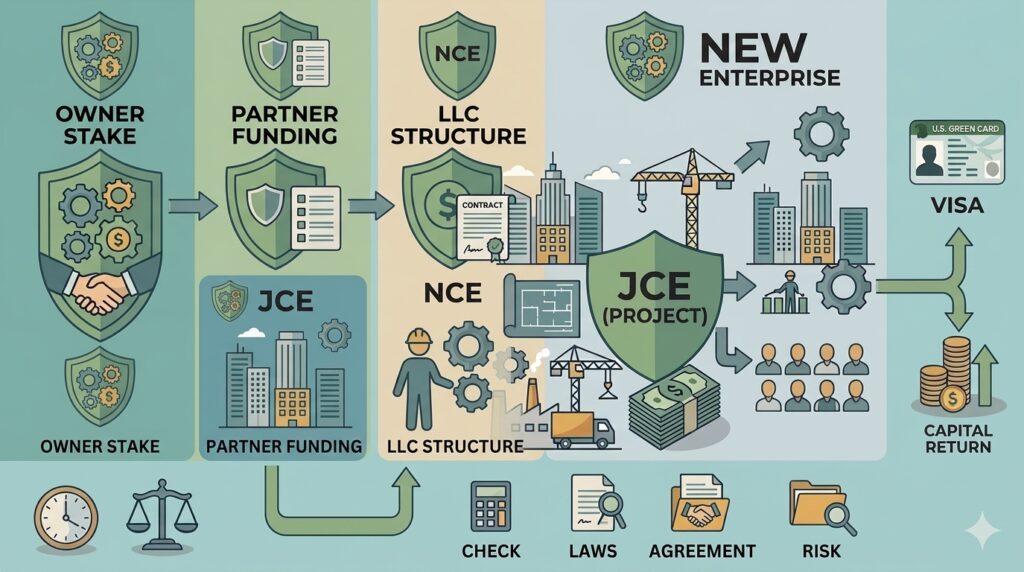
When I explain EB-5 project documents to investors, I often see one common misunderstanding. Many investors hear the phrase “equity owner” and assume they will become an owner of the actual hotel, apartment building, development project, or operating business.
In most EB-5 regional center projects, that is usually not the case.
Most investors invest into the NCE, or New Commercial Enterprise. The NCE is the legal investment entity that accepts EB-5 capital from investors. The NCE may then lend or invest that capital into the JCE, or Job-Creating Entity, which is the entity that actually develops, builds, operates, or expands the project.
USCIS explains that EB-5 investors must invest capital into a new commercial enterprise, and that the investment must be connected to job creation. The new commercial enterprise may be structured in different legal forms, such as a partnership, corporation, joint venture, business trust, or limited liability company.
The NCE: The Entity You Usually Join
In many regional center projects, the NCE is structured as either a Limited Partnership or a Limited Liability Company.
That means you may become either a Limited Partner or an LLC Member.
| Investor Role | Simple Meaning |
|---|---|
| Equity Owner | A broad term meaning you own an interest in an entity, usually the NCE. |
| Limited Partner | You own a limited partnership interest in an NCE structured as a limited partnership. |
| LLC Member | You own a membership interest in an NCE structured as an LLC. |
The important point is simple:
Ownership does not always mean control.
You may own an interest in the investment entity, but you usually do not control the project’s daily operations, construction decisions, refinancing, sale, or repayment timing.
Equity Owner: A Broad Label
“Equity owner” sounds powerful, but it is only a general description. It means you hold an ownership interest in a legal entity.
In EB-5, that entity is usually the NCE.
For example, if the EB-5 project is a hotel development, you may own an interest in the NCE that lends money to the hotel project company. But you may not directly own the hotel, the land, or the operating company.
This means you may not have the right to choose the contractor, approve the budget, control the construction schedule, or force the project to repay early.
That is why I always tell investors:
Do not stop at the word “owner.” Read the documents to understand what you actually own.
Limited Partner: Passive Investor with Defined Rights
Many EB-5 funds are structured as limited partnerships. In that structure, EB-5 investors usually become Limited Partners, while a General Partner manages the partnership.
A limited partner usually contributes capital and has limited liability, but does not manage the day-to-day business.
This structure is common because many EB-5 investors do not want to actively operate a U.S. business. They want a compliant investment structure that supports their immigration process.
A limited partner may have certain rights, such as:
| Possible Right | What It Usually Means |
|---|---|
| Information Rights | Receiving reports, tax documents, and project updates. |
| Economic Rights | Receiving interest, preferred return, or distributions if available. |
| Limited Voting Rights | Voting on certain major matters, depending on the agreement. |
| Transfer Rights | Transferring the interest only under specific restrictions. |
However, these rights are not automatic. They must be written in the Limited Partnership Agreement and other project documents.
LLC Member: Ownership Through an LLC
Some EB-5 NCEs are structured as LLCs. In this case, the investor becomes an LLC Member.
An LLC member owns a membership interest in the LLC. But if the LLC is manager-managed, the manager or managing member usually controls most business decisions.
This means the investor may still be passive.
| Question | Why It Matters |
|---|---|
| Who is the manager? | This party usually controls the NCE. |
| What can the manager decide alone? | This affects amendments, repayment, and redeployment. |
| Do members have voting rights? | Some rights may be limited. |
| Can the manager redeploy funds? | This may affect how long your money remains invested. |
An LLC structure can be normal in EB-5, but investors should understand exactly what powers the manager has.
📄 Your Documents Define Your Real Role
Your actual role is not defined by marketing materials. It is defined by the legal documents.
| Document | Why It Matters |
|---|---|
| PPM | Explains risks, fees, conflicts, structure, and exit terms. |
| Subscription Agreement | Confirms your agreement to invest. |
| Limited Partnership Agreement | Defines your rights if the NCE is a limited partnership. |
| Operating Agreement | Defines your rights if the NCE is an LLC. |
| Redeployment Policy | Explains what may happen if funds are repaid before your EB-5 process ends. |
These documents tell you who manages the NCE, what rights you have, whether you can vote, whether you can transfer your interest, and who controls major decisions.
What Investors Should Not Assume
Many investors assume that because they are “owners,” they can control the project. In most EB-5 regional center projects, this is not realistic.
| Investor Assumption | Typical Reality |
|---|---|
| “I own the project.” | Usually, you own an interest in the NCE, not the actual project. |
| “I can withdraw anytime.” | EB-5 investments are usually illiquid. |
| “I decide when repayment happens.” | Repayment depends on project documents. |
| “I control redeployment.” | The manager may have broad authority. |
| “I manage the business.” | The general partner or manager usually controls operations. |
This does not mean the structure is bad. It simply means investors should understand their real position before investing.