
When I speak with EB-5 investors for the first time, one of the most common questions I hear is: “Who am I actually investing in?”
Many investors assume they are investing directly into a hotel, apartment building, hospital, infrastructure project, or real estate development. In many regional center EB-5 projects, that is not exactly how the structure works.
What does NCE mean?
USCIS explains that EB-5 eligibility generally requires three key elements: an investment of capital, engagement in a new commercial enterprise, and job creation. In simple language, this means an EB-5 investor cannot just place money into a passive account and expect to qualify. The investment must be made into a qualifying business structure that is connected to job creation.
A New Commercial Enterprise is generally a for-profit business entity formed in the United States for the ongoing conduct of lawful business. USCIS also describes a new commercial enterprise as a qualifying business organization, which may include different legal forms such as a partnership, corporation, limited liability company, joint venture, business trust, or other publicly or privately owned entity.
In most modern regional center projects, the NCE is commonly structured as a limited partnership or limited liability company. As the EB-5 investor, you usually become a limited partner or LLC member of the NCE after you sign the subscription documents and your investment is accepted.
The NCE is the investor-facing entity
The easiest way I explain it to investors is this:
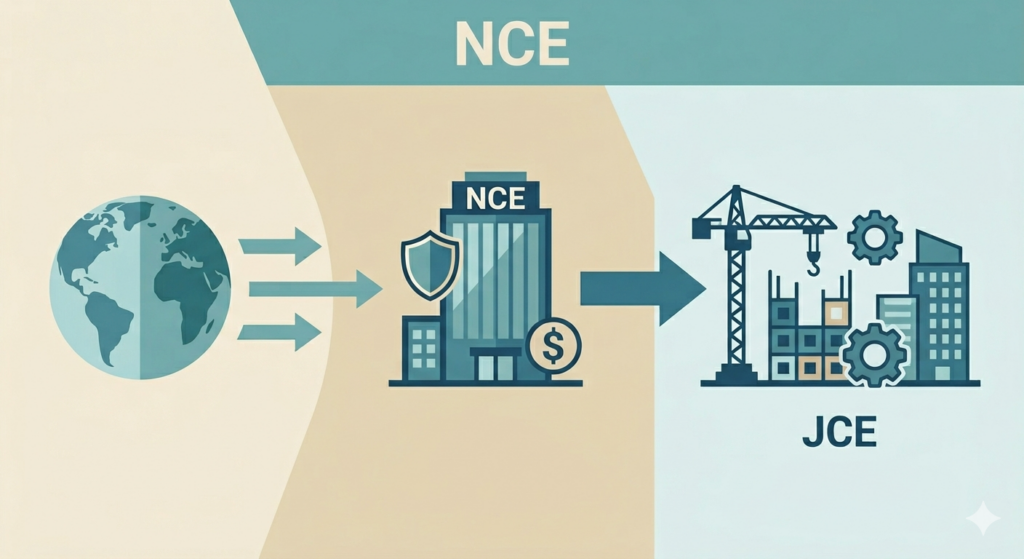
The NCE is the entity you invest into. The JCE is usually the entity that uses the money to build or operate the project.
In a typical regional center structure, investors contribute their EB-5 capital to the NCE. The NCE then deploys that capital to the JCE, or Job-Creating Entity, usually through a loan, preferred equity, mezzanine financing, or another investment structure. Several EB-5 industry platforms explain the NCE as the investment vehicle that receives EB-5 investor capital and then makes a qualifying investment into the project or JCE.
This is why I call the NCE the investor-facing entity. Your subscription agreement, operating agreement, limited partnership agreement, investor rights, distribution terms, withdrawal restrictions, and many project-related disclosures are usually connected to the NCE.
You may see the project name in marketing materials, but legally, your investment relationship is often with the NCE.
Why does the NCE exist?
The NCE exists because EB-5 regional center projects often involve multiple investors. Instead of each investor directly lending money to, or investing in, the project company, the NCE collects EB-5 funds from many investors and deploys them as one organized investment.
This structure can make the project easier to manage. It allows the regional center, project sponsor, fund manager, or NCE manager to organize investor subscriptions, capital deployment, reporting, and immigration-related documentation.
For example, imagine a project needs $80 million of EB-5 capital. Instead of 100 separate investors each negotiating directly with the developer, the project may create one NCE. Each investor subscribes to the NCE, and the NCE then provides the combined capital to the JCE under one main loan agreement or investment agreement.
For investors, this structure is efficient, but it also means you must understand your position clearly. You are usually not directly controlling the project. You are participating through the NCE.
What documents should you review at the NCE level?
The Private Placement Memorandum, which explains the investment structure, risks, fees, conflicts of interest, repayment terms, and project strategy.
The Subscription Agreement, which is the document you sign to join the investment.
The Operating Agreement or Limited Partnership Agreement, which explains your rights as an LLC member or limited partner.
The Loan Agreement or investment agreement between the NCE and JCE, which explains how the NCE will deploy your capital to the project.
The Escrow Agreement, if your funds are first placed into escrow before being released.
The Redeployment Policy, if applicable, which explains what may happen if the project repays the NCE before your EB-5 immigration process is fully completed.
What should investors ask about the NCE?
Before investing, I believe every EB-5 investor should ask several basic questions:
Who manages the NCE?
Is the NCE a limited partnership or LLC?
What rights do investors have?
How does the NCE deploy money to the JCE?
Is the NCE making a senior loan, mezzanine loan, preferred equity investment, or another type of investment?
Does the NCE have collateral or security?
What fees are paid at the NCE level?
Who controls redeployment decisions?
What reports will investors receive?
What happens if the project, regional center, NCE, or JCE has a compliance issue?
These questions are especially important after the EB-5 Reform and Integrity Act. USCIS has issued guidance addressing compliance consequences for regional centers, NCEs, JCEs, and investors, and EB-5 entities may face sanctions for certain noncompliance. This is one reason investors should look beyond marketing materials and understand the legal structure behind the project.
My view
In my experience, investors who understand the NCE make better EB-5 decisions.
That is the right mindset.
The NCE is not just an administrative entity. It is the legal bridge between your EB-5 capital and the actual project. Understanding it helps you read the documents more carefully, ask better questions, and avoid relying only on sales presentations.
For any EB-5 investor, learning what the NCE is should be one of the first steps in project review. Your uploaded EB-5 resource list also includes USCIS, EB5AN, EB5 United, EB5 Investors, and other industry sources that are useful for building this type of investor education content.