
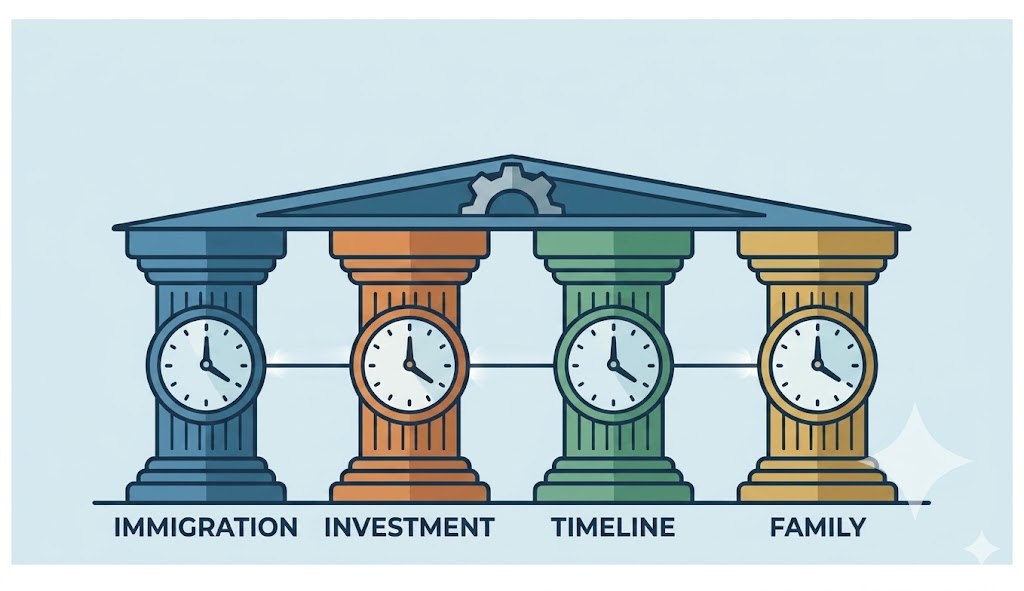
In my experience, EB-5 is rarely just about one person. Most investors I speak with are not only thinking about themselves. They are thinking about their spouse, their children, education planning, future work opportunities, and whether the whole family can have a more stable option in the United States.
“If I invest in EB-5, can my family get green cards together with me?”
The general answer is yes, but with important limits. An EB-5 principal investor may usually include a legal spouse and unmarried children under the age of 21. This means one EB-5 investment may potentially support the immigration process for the investor, spouse, and eligible children.
However, this is also where many families make mistakes. Some investors assume all family members can be included. Some wait too long when their child is close to 21. Some do not understand how marriage, divorce, student status, or visa backlog may affect the case.
That is why family planning should happen at the very beginning of the EB-5 process — not after the project is selected and not after the petition is filed.
1. The principal investor
The principal investor is the person who makes the EB-5 investment and files the main EB-5 petition. For regional center investors, the main petition is generally Form I-526E. USCIS describes Form I-526E as the petition used by a regional center investor to request classification as an immigrant investor.
The principal investor does not always have to be the main income earner in the family, but the source of funds must be clearly documented. For example, one spouse may be the principal investor even if the investment money comes from jointly owned marital assets, a gift from parents, business income, property sale proceeds, or other lawful sources. The key issue is not only who files the petition, but whether the lawful source and path of funds can be proven.
Families should decide early who should be the principal investor. In some cases, the choice may depend on who owns the assets. In other cases, it may depend on tax planning, business ownership, marital property rules, children’s age, or travel plans. This decision should be made with both an immigration attorney and, where needed, a tax or financial advisor.
2. The spouse
A legally married spouse can generally be included as a derivative beneficiary in the EB-5 process. This means the spouse does not need to make a separate EB-5 investment. The spouse may obtain conditional permanent residence together with the principal investor, assuming all immigration requirements are met and visas are available.
However, the marriage must be legally valid. If a couple is engaged but not married, the fiancé or fiancée is not automatically included as a spouse. If a couple plans to marry soon, timing may become important. They should discuss whether to marry before filing the EB-5 petition or before the immigrant visa / adjustment stage.
Divorce can create complications. If the principal investor and spouse divorce before the spouse obtains permanent residence, the spouse’s eligibility as a derivative may be affected. If divorce occurs after conditional green cards are issued, the situation may require legal advice regarding how the spouse can continue the process. Families should not assume that derivative status is always protected after major family changes.
3. Unmarried children under 21
Unmarried children under 21 may generally be included as derivative beneficiaries. This is one of the most important benefits of EB-5 for families. A single EB-5 investment may potentially support immigration benefits for the investor, spouse, and qualifying children.
However, two conditions are critical: the child must be under 21, and the child must be unmarried. If a child gets married, that child may no longer qualify as a derivative child in the EB-5 case. If a child is close to turning 21, the family must carefully analyze age-out risk.
Age-out risk is one of the most common planning issues in family EB-5 cases. A child who is 19 or 20 at the time of filing may still face risk depending on processing time and visa availability. Families should not wait until a child is almost 21 before seeking legal advice. The earlier the family reviews timing, the more options may be available.
4. Children studying in the United States
Many EB-5 families already have children studying in the United States on F-1 student visas. In these cases, EB-5 may be part of a longer education and immigration plan.
However, families should understand that filing an immigrant petition may affect future nonimmigrant visa applications or travel plans. A student visa is generally a temporary nonimmigrant status, while EB-5 reflects immigrant intent. This does not mean the child cannot study in the U.S., but it does mean the family should coordinate strategy carefully.
If the child is in the United States and a visa is available, adjustment of status may be possible in some cases. USCIS has stated that if an immigrant visa is immediately available, an applicant may file Form I-485 to adjust status.
This can be especially important for families who want children to remain in the U.S. while the green card process moves forward. But adjustment strategy depends on current status, visa availability, travel needs, and legal eligibility.
5. Parents of the investor
Parents of the principal investor cannot be included as derivative beneficiaries in an EB-5 application unless they independently qualify as the investor’s spouse or child, which usually does not apply. This is a common misunderstanding.
For example, if an adult child makes an EB-5 investment, that child cannot include parents as derivatives. If parents want green cards through EB-5, one parent may need to become the principal investor, with the other parent as spouse. Alternatively, after the child becomes a U.S. citizen in the future, family sponsorship may become a separate possibility, but that is not part of the EB-5 derivative process.
6. Siblings and extended family
Siblings, grandparents, cousins, nephews, nieces, and other extended family members cannot be included in one EB-5 application as derivatives. Each family unit usually needs its own immigration strategy.
This is important for families who want to immigrate together with multiple adult children or relatives. EB-5 may be able to cover one nuclear family unit, but not an entire extended family under one investment. If multiple adult children each have their own spouse or children, each family may need separate planning.
7. Family coverage and visa numbers
Each derivative family member still uses an immigrant visa number. This means family size can matter in countries with high EB-5 demand. Visa availability is tracked through the monthly Visa Bulletin issued by the U.S. Department of State.
For families from countries with visa backlogs, the number of included family members, children’s ages, and the timing of filing can all become important. Investors should not only ask “Can my child be included?” They should also ask “Will my child still be eligible when the visa becomes available?”