
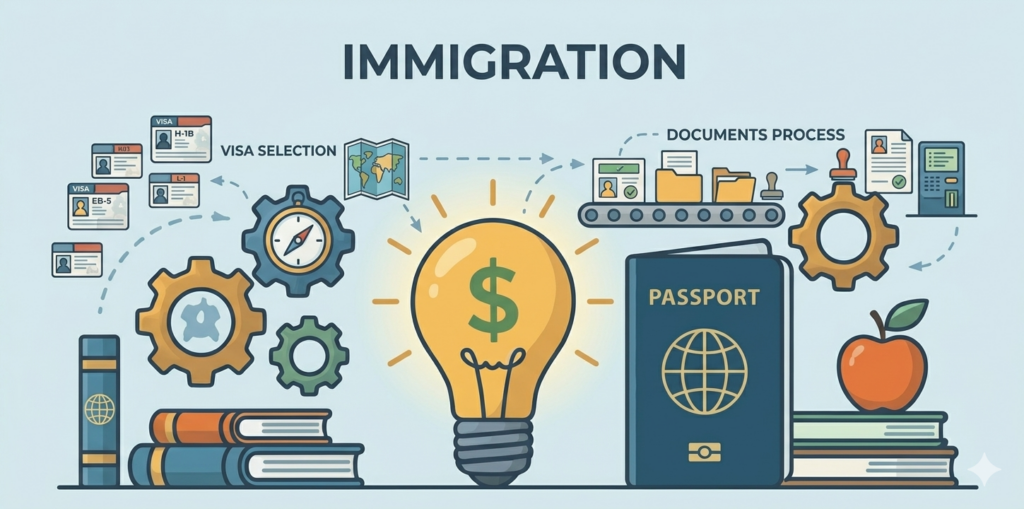
The EB-5 process is not a single-step application. It is a complete immigration and investment journey that begins when an investor starts learning about EB-5 and continues until the investor and eligible family members receive permanent green cards.
In the EB-5 University Process Section, we will focus on each major stage of the EB-5 journey. Our goal is to help investors understand the process, key USCIS requirements, important timelines, and practical considerations before making major decisions.
If you are new to the EB-5 program, the following overview can help you understand the main stages from project selection to permanent green card approval.
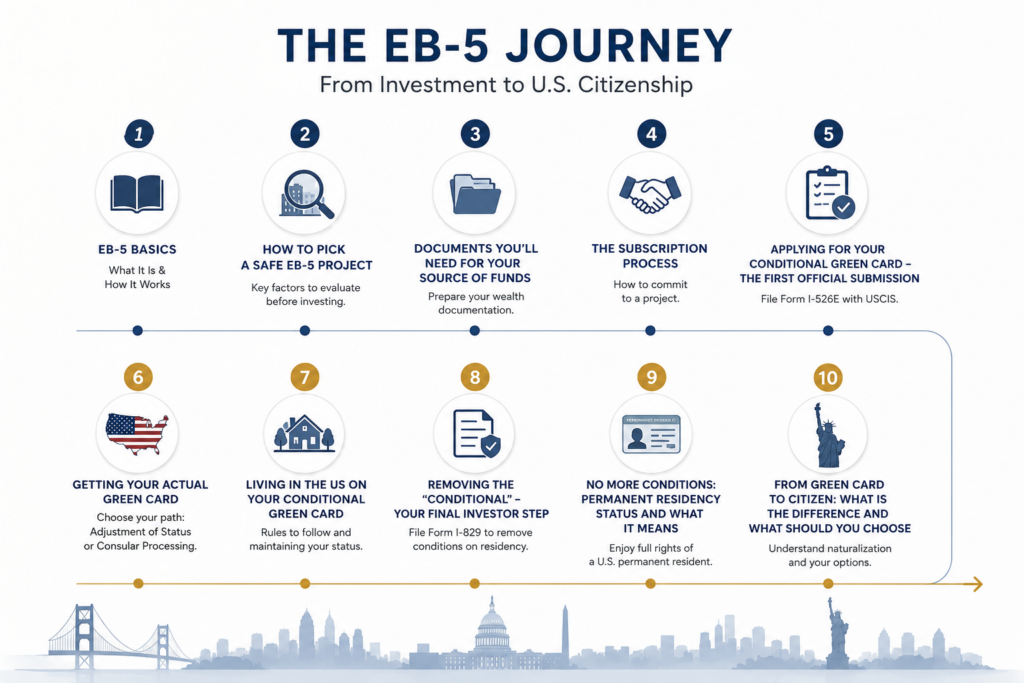
Click any step below to jump directly to that section:
- EB5-basics1. EB-5 Basics: What It Is & How It Works
- How to Pick a Safe EB-5 Project
- Documents You’ll Need for Your Source of Funds
- The Subscription Process: How to Commit to a Project
- Applying for Your Conditional Green Card – the First Official Submission
- Getting Your Actual Green Card (Choose Your Path)
- Living in the US on Your Conditional Green Card and the Rules to Follow
- Removing-the-Conditional
- Permanent Residency Status Approval
- From Green Card to Citizen
1. EB-5 Basics: What It Is & How It Works
Before selecting any EB-5 project, investors should first understand what the EB-5 program is and whether it fits their family’s immigration plan. At this stage, investors should learn the basic EB-5 requirement: a qualifying investment must create at least 10 full-time U.S. jobs. Investors should also clarify their main goals, such as U.S. relocation, children’s education, long-term residency, future citizenship planning, or asset diversification.
It is also important to understand who can be included in the EB-5 application. In general, the main investor may include a spouse and unmarried children under the age of 21. Investors should also review the expected timeline, total costs, immigration risks, project risks, and liquidity limitations before moving forward.
Another important question is whether the investor will apply from inside or outside the United States, because this may affect the later green card application process.
2. How to Pick a Safe EB-5 Project
Project selection is one of the most important stages in the EB-5 process. The project can affect both immigration success and the potential return of investment capital.
Before making a decision, investors should review the project structure, developer background, regional center history, capital stack, loan terms, job creation plan, exit strategy, and risk disclosures. In EB-5 Project Section, we will provide more insight about Project terms and case studies.
In general, investors should pay attention to several key areas:
Immigration risk: Can the project support I-526E and I-829 approval?
Financial risk: Can the project protect and potentially return investor capital?
Timing risk: Will the project create the required jobs within the required period?
Compliance risk: Are the regional center, NCE, and JCE properly structured?
A strong EB-5 project should not only look attractive from an investment perspective, but also provide a clear and credible path to meeting EB-5 immigration requirements.
3. Documents You’ll Need for Your Source of Funds
After choosing a project, the investor must prepare documents proving that the investment capital came from lawful sources.
This is usually one of the most document-heavy stages of the EB-5 process. Investors may need to show income from salary, business ownership, property sales, investment gains, inheritance, gifts, loans, or company dividends.
USCIS generally wants to see a clear path of funds from the original source to the EB-5 investment. This means investors may need to provide bank statements, tax records, employment records, business registration documents, property sale contracts, loan agreements, gift declarations, and wire transfer records.
Different countries may require different documentation strategies due to banking rules, tax systems, and currency control policies. Therefore, investors should start preparing source of funds documents as early as possible.
4. The Subscription Process : How to Commit to a Project
Once the investor is comfortable with the project and has started preparing source of funds documents, the next step is to formally subscribe to the EB-5 project.
To “subscribe” to a project means the investor signs the required project documents and commits to investing in that specific EB-5 project. These documents may include a subscription agreement, operating agreement, escrow agreement, investor questionnaire, and risk disclosures.
After signing the documents, the investor transfers the required EB-5 investment capital. In many cases, the investor may also need to pay a separate administrative fee to project side.
Before transferring funds, investors should clearly understand when the money will be released from escrow, whether the investment is refundable under any condition, what happens if the I-526E petition is denied, when the investment period starts, and what the expected exit strategy is.
5. Applying for Your Conditional Green Card-the First Official Submission
This is the main investor petition stage.
For most regional center investors, the relevant petition is Form I-526E. This form is used by regional center investors to petition for immigrant investor status. For direct EB-5 investors, Form I-526 may apply instead.
The petition usually includes both investor-specific documents and project-related documents. Investor-specific documents mainly focus on identity, family information, and source of funds. Project documents usually include the business plan, economic report, offering documents, and other materials showing that the project can meet EB-5 requirements.
After USCIS reviews the petition, there are several possible outcomes:
Approval: USCIS accepts the petition.
RFE: USCIS issues a Request for Evidence and asks for more documents or clarification.
NOID: USCIS issues a Notice of Intent to Deny, meaning there are serious concerns that must be addressed.
Denial: USCIS rejects the petition.
6. Getting Your Actual Green Card (Choose Your Path)
After filing the I-526E or I-526 petition, the investor enters the waiting period. During this time, USCIS reviews the petition and may request additional information.
Investors should also monitor visa availability. The investor’s country of birth, visa category, and priority date may affect when they can move forward to the green card application stage.
During this stage, investors should monitor:
- I-526E or I-526 case status
- Visa Bulletin movement
- Reserved or unreserved visa category
- Whether the priority date is current
- Whether they can proceed with adjustment of status or consular processing
7. Living in the US on Your Conditional Green Card and the Rules to Follow
After I-526E approval, or in some cases while the petition is still pending if concurrent filing is available, the investor may move to the green card application stage with 2 type of routes :
Adjustment of Status, Form I-485:
This route is generally for investors who are already legally inside the United States and are eligible to adjust status.
Consular Processing, DS-260:
This route is generally for investors who are outside the United States. The case is transferred to the National Visa Center, and the investor submits the DS-260 immigrant visa application.
For consular processing, the investor usually needs to prepare civil documents, complete a medical exam, and attend a U.S. consulate interview. After the immigrant visa is approved, the investor enters the United States and becomes a conditional permanent resident.
8. Filing Form I-829 to Remove Conditions
After receiving the conditional green card, the EB-5 process is not finished. The first EB-5 green card is generally valid for two years and comes with conditions.
Before the conditional green card expires, the investor must file Form I-829 to remove those conditions. At this stage, USCIS reviews whether the investor made the required investment, kept the capital at risk, and whether the project created, or is expected to create, the required jobs.
The immigration attorney usually prepares the I-829 filing, but the NCE, regional center, or project manager often provides project updates, job creation evidence, and other supporting documents.
Investors should monitor the project during the conditional residence period and speak with an attorney early if there are delays, financial issues, or major project changes.
9. Permanent Residency Status Approval
If USCIS approves Form I-829, the conditions on the investor’s green card are removed.
The investor, spouse, and eligible children become lawful permanent residents without conditions. This is often called receiving the permanent green card.
I-829 approval means the EB-5 immigration requirements have been successfully completed. However, it does not automatically mean the investment capital will be returned immediately. The timing of repayment depends on the project documents, investment structure, business performance, and exit strategy.
10. From Green Card to Citizen
After receiving a permanent green card, some EB-5 investors may think about becoming a U.S. citizen.
A green card allows the investor and family to live, work, and study in the United States. However, green card holders still need to maintain their permanent resident status and should be careful with long periods outside the United States.
U.S. citizenship gives more rights, such as applying for a U.S. passport and voting in U.S. elections. Citizenship is more permanent than a green card, but it may also affect tax, nationality, and family planning.
Not every investor needs to become a U.S. citizen. Some families only want permanent residence, while others want to make the United States their long-term home. The best choice depends on the investor’s family plan, lifestyle, business, tax situation, and future goals. Investors should speak with immigration and tax advisors before making this decision.
Conclusion
The EB-5 process is a long-term journey that requires both immigration planning and investment due diligence. From learning the basics and choosing a project, to preparing source of funds, filing petitions, obtaining conditional residence, and finally removing conditions, each stage plays an important role.
For investors, understanding the full process before making a decision can help reduce uncertainty and improve preparation. EB-5 is not only about making an investment; it is about building a clear path toward permanent residence for the investor and their family.