
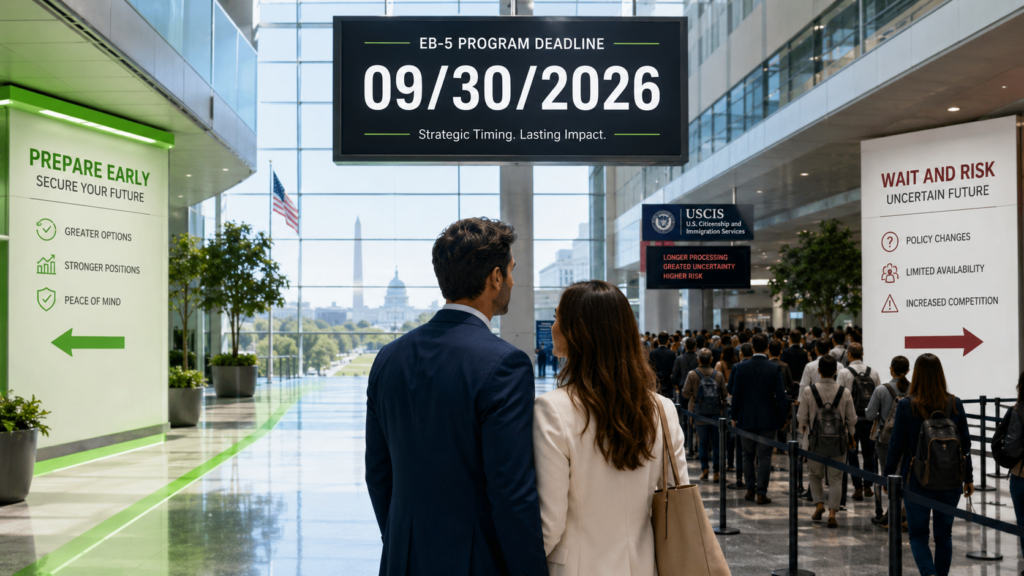
September 30, 2026 is becoming one of the most important dates for EB-5 investors to understand. It is not the official expiration date of the EB-5 Regional Center Program. The program is currently authorized through September 30, 2027. However, September 30, 2026 is widely viewed as the key deadline for stronger “grandfathering” protection under the EB-5 Reform and Integrity Act.
For investors, this distinction is important. An investor who files Form I-526E on or before September 30, 2026 may receive protection that allows USCIS to continue processing the petition even if the Regional Center Program is not renewed after 2027. By contrast, investors who file after September 30, 2026 may still be able to file before the program’s 2027 authorization date, but they may not receive the same level of protection if Congress does not extend the program again.
This deadline has become more meaningful under the current Trump administration because U.S. immigration policy has become more politically uncertain. President Trump has publicly promoted a new “Gold Card” program as an alternative investment-based immigration pathway. On September 19, 2025, the White House issued an executive order establishing the Gold Card program, with a required gift amount of $1 million for an individual applicant and $2 million for a corporation or similar entity sponsoring an individual. The order also stated that agencies should consider expanding the Gold Card concept to visa applicants under EB-5.
At the same time, the Gold Card does not currently replace EB-5 as a congressionally established immigrant investor program. EB-5 remains a statutory program with defined investment, job creation, project, and regional center requirements. The Gold Card is a newer executive-branch initiative, and its long-term legal and practical impact is still developing. Reuters reported in April 2026 that only one person had been approved under the Gold Card program at that time, while hundreds of applicants were still undergoing vetting.
For EB-5 investors, the current policy environment creates two practical messages. First, EB-5 remains available, but political risk is higher as the 2026 and 2027 deadlines approach. Second, investors who want to reduce future policy uncertainty may have a stronger reason to prepare earlier and file before September 30, 2026.
There are also signs of stronger compliance enforcement. USCIS has emphasized EB-5 Integrity Fund obligations, including annual regional center fees, and stated that failure to pay required fees may lead to regional center termination action. This shows that the post-RIA EB-5 environment is not only about investment and job creation, but also about regional center compliance, documentation, and government oversight.